How PINKY LEEM Thinks About Professional Lash Equipment
Every piece of equipment in a lash room exists because someone asked a simple question: can this be better?
For decades, lash extensions have been applied with adhesives that cure by reacting with moisture in the air. That chemistry works, and skilled artists get excellent results from it every day. But it ties the artist to conditions she does not fully control. The glue sets on its own schedule, not hers.
Light-cured systems change which variable is in charge. That is the real story, and it is more interesting than the marketing version.
This article explains the engineering choices behind a UV lash lamp, and it is equally clear about what this technology does not solve.
What Actually Happens When Lash Adhesive Cures
Conventional lash extension adhesives are built mainly on ethyl cyanoacrylate. Cyanoacrylate is a liquid monomer that polymerises — individual molecules chain together into a solid — when moisture triggers the reaction. The humidity in the room and the micro-moisture on the client’s natural lash are what start it.
Because airborne water vapour drives the process, the adhesive is bound to its environment. Conventional glues are typically rated for a specific relative humidity window, often around 30–80% RH, and most perform best in a narrow temperature band near 18–22°C. Drift outside that window and two familiar problems appear. Too dry, and the glue cures slowly, leaving stickies and weak attachment. Too humid, and it shock-cures into a brittle bond that pops off during brushing.
Light-cured adhesives keep the same chemical family but swap the trigger. They include photoinitiators — compounds that stay inert until they absorb a specific wavelength of light. The artist dips, places the extension, and the adhesive stays liquid. She adjusts the placement as long as she needs. Then she activates the lamp for one to three seconds, the photoinitiators absorb the light energy, decompose into reactive species, and polymerisation happens on command.
The innovation is not speed. It is control over timing — the artist decides when the bond sets, instead of racing a clock she did not start.
The “UV” in UV Lash Lamps Is Mostly a Borrowed Word
Here is a piece of honesty the industry rarely offers: most professional light-curing lash systems are not really UV devices in the way the name suggests.
They use LED lamps emitting light near the boundary between UV-A and visible light, typically in the 395–405 nm range. The term “UV lashes” is largely marketing shorthand borrowed from the gel nail industry. One lash education provider puts the wavelength around 395 nm and notes that this part of the spectrum emits minimal harmful rays compared with the sources people imagine when they hear “UV”.
The power difference matters as much as the wavelength. Light-curing lash lamps are low-wattage devices, generally in the 5–10 W range. For scale, the same education provider compares a typical 5 W lash lamp with a nail lamp at 50 W or more, and a tanning bed at 1,500–2,000 W.
PINKY LEEM builds to the 395–405 nm band because that is where the photoinitiators in compatible adhesives are activated efficiently. The wavelength is an engineering requirement derived from the chemistry, not a feature chosen for a spec sheet.
Ask any supplier for the actual wavelength data sheet for the lamp, including ours — a wavelength claim without documentation is a sentence, not a specification.
Why the Lamp and the Adhesive Have to Be Treated as One System
This is the point most buyers underestimate.
A light-curing lamp does not cure lash glue in general. It cures adhesives whose photoinitiators respond to the wavelength that lamp emits. Most manufacturers recommend using the lamp and adhesive as a matched system for both efficiency and safety. Pairing a lamp with an adhesive it was never matched to is how artists end up with partially cured bonds, and a partially cured acrylate is the worst of both worlds — weak retention plus uncured chemistry sitting near the eye.
This is why PINKY LEEM supplies compatible UV adhesive alongside the lamp rather than selling the hardware alone. It is not an upsell structure. It is the only configuration in which the wavelength specification means anything.
Buying a lamp and sourcing adhesive separately on price is the single most common way a light-cured setup underperforms.
The Design Decisions, and the Reasoning Behind Each
Cold LED light. LEDs in this configuration produce very little heat at the working surface. For a device operating near the eyelid during repeated short bursts, low thermal output is a basic design requirement rather than a comfort upgrade.
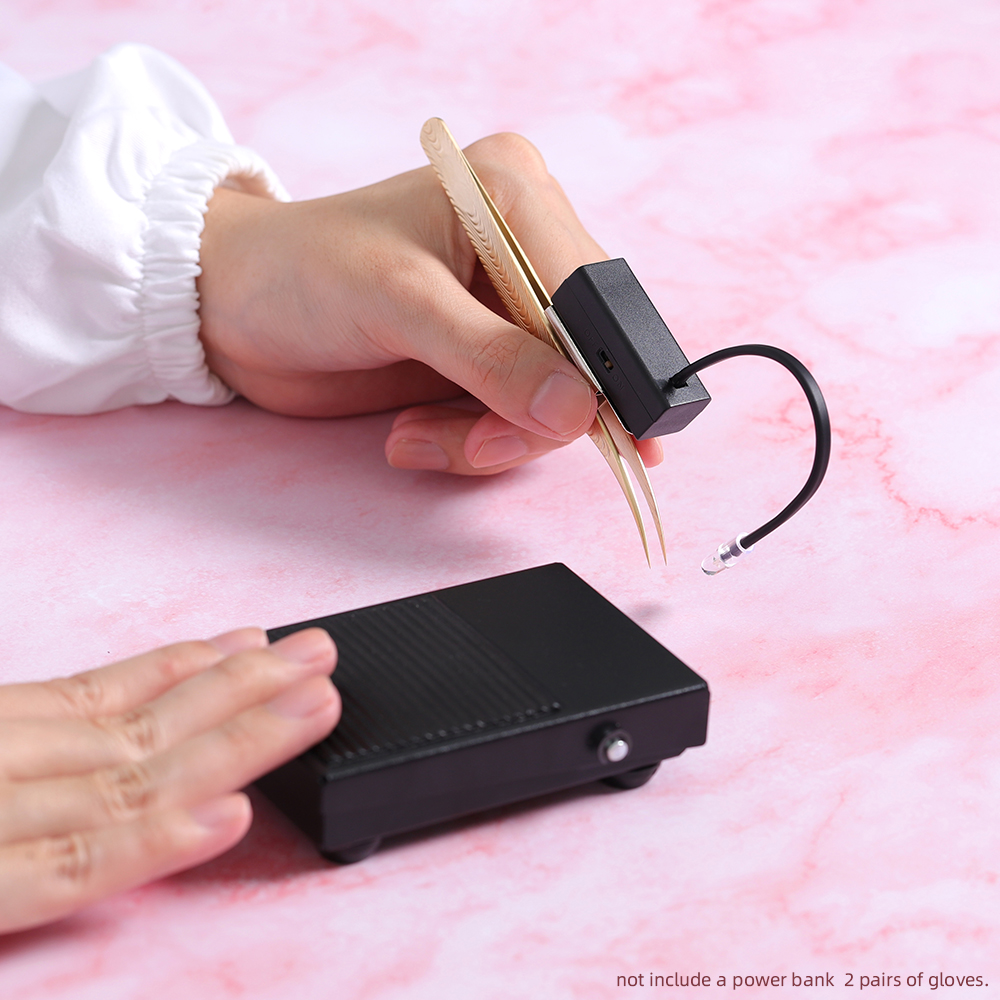
A foot pedal instead of a hand switch. This looks trivial and is not. Light-cured workflows involve pressing a trigger after every placement. When both hands hold tweezers under magnification, routing the activation to a foot pedal keeps the isolation intact. Over a full set, that is hundreds of placements where the hands never leave the work.
An adjustable head. The lamp must be aimed at the lash line from whatever angle the client’s position dictates. Precise positioning is not an aesthetic preference — correct lamp positioning is part of the safety protocol in every serious discussion of these systems.
Metal housing and a compact footprint. A lamp arm, a pedal routed under the bed and protective eyewear all need to fit into a room laid out before the device existed. Durability and size are workflow considerations.
OEM customisation. PINKY LEEM offers branded customisation for lash brands and distributors building their own equipment lines.
Every one of these choices traces back to how the device is physically used during a set, not to how it photographs.
What Certification Marks Do and Do Not Tell You
PINKY LEEM products carry CE, RoHS and FCC marks. It would be easy to leave that sentence sitting next to a safety claim and let readers connect them. That connection would be wrong, and professionals deserve the accurate version.
FCC rules address radio frequency interference and radio transmission in the United States. They say nothing about whether a product is safe to touch. CE marking is a European declaration that the applicable directives have been met — depending on the product, electrical safety through the Low Voltage Directive, electromagnetic compatibility through the EMC Directive, and restrictions on hazardous substances. It is a marking system rather than a single certificate, and the manufacturer signs the declaration. RoHS specifically restricts hazardous substances in the materials.
What none of these three addresses is the photobiological effect of the emitted light on the eye. That is the domain of a different standard, IEC/EN 62471, which classifies light sources into risk groups by photobiological hazard, from Exempt (no photobiological hazard) upward.
So the correct statement is this: these marks confirm the device is a properly constructed, electrically sound, interference-compliant piece of equipment. They are not an ophthalmic safety verdict. Any supplier — including us — who implies otherwise is overstating what the paperwork covers.
If eye-safety documentation matters to your purchase, ask specifically for the photobiological assessment, not the electrical certificates.
The Claims We Will Not Make
Several benefits attached to light-cured lash systems do not survive scrutiny, and repeating them would make this article worthless.
We will not claim this eliminates allergies. Most light-cured lash adhesives remain acrylate or cyanoacrylate chemistry — the light changes the initiator trigger, not the underlying chemical family. Sensitisation develops when skin contacts uncured acrylates, and the nail industry’s wave of acrylate allergies is the cautionary precedent. For a client with a proven severe cyanoacrylate allergy, light-cured adhesive is usually not a safe workaround. Patch testing and proper consultation still apply.
We will not claim guaranteed six-to-eight-week retention. Adhesives do not pause the lash growth cycle. The average person sheds natural lashes daily, and no adhesive keeps an extension on a lash that has shed. One education provider reports real-world retention for light-cured sets at roughly 2–3 weeks, comparable to conventional extensions. Retention is governed by prep, isolation, attachment and lash health — not by the cure mechanism.
We will not publish a specific time-saving percentage. The time saving is real in principle, because there is no waiting for glue to set. But the actual figure depends on the artist’s existing speed, her technique and her set style. We have no measured study to cite, so we are not going to invent a number.
We will not tell you UV lamp safety is a settled question. Long-term data specific to repeated ocular exposure in lash applications is still developing. One education institution reviewing this technology concluded that more research is needed on long-term effects and declined to add UV lash training to its curriculum on that basis. That is a reasonable professional position, and we would rather you hear it from us than discover we omitted it.
A supplier willing to name the limits of its own product category is the one whose remaining claims are worth something.
What the Protocol Actually Requires
If you work with a light-cured system, the equipment is only half of it.
Protective measures are not optional accessories. Light-cured workflows require protective eye pads or UV-blocking tape over the upper lid for the client, and the client’s eyes stay closed throughout. The artist’s own protection matters too — UV400 protective eyewear is the recommendation for the person holding the lamp all day. Strict compliance with shielding and lamp positioning is described as non-negotiable precisely because the long-term data is incomplete.
There are operational changes as well. Fully cross-linked photo-cured bonds show higher solvent resistance than standard cyanoacrylate, so removal often requires specialised or system-matched removers rather than a standard cream remover. Home removal is not viable.
In some markets there are compliance obligations beyond technique. UK technicians are advised to confirm that their insurance covers light-cured systems before offering the service, since many insurers treat it as a distinct treatment modality requiring accredited training. Regulatory frameworks are still catching up — in the US, the FDA does not regulate lash adhesives as drugs, and specific standards for UV/LED lash systems in several jurisdictions remain under development.
Buy the training and the protocol with the hardware, or the hardware is a liability rather than an upgrade.
Who This Technology Is Actually For
Being honest about the limits makes it easier to be useful about the fit.
Light-cured systems suit artists who have mastered conventional adhesive and are hitting a ceiling set by their environment rather than their technique — a studio with uncontrollable humidity swings, or a mobile artist working in unfamiliar rooms. The humidity independence is largely real, because light replaces moisture as the catalyst. Shock curing stops being a failure mode. They also suit highly detailed work where unlimited placement time changes the outcome; cure-on-command is the claim that holds up best.
They make less sense as a fix for retention problems caused by prep or isolation. Oil or dust on the natural lash breaks the bond regardless of cure method.
The honest buying question is not whether the technology works, but whether the constraint it removes is the one actually limiting your work.
Where PINKY LEEM Stands
We build lash equipment, and we would like you to buy ours. That is the commercial reality, and pretending otherwise would be strange in an article on our own site.
What we are not willing to do is sell this category on claims the evidence does not support. The curing mechanism is real chemistry with a genuine workflow advantage. The wavelength and power figures are modest and documented. The allergy and retention promises circulating in the market are not supported, the long-term ocular data is incomplete, and the certification marks on our boxes cover electrical and interference compliance rather than eye safety.
The science is worth the investment. The marketing around it usually is not — and knowing which is which is what separates a professional purchase from an impulse one.