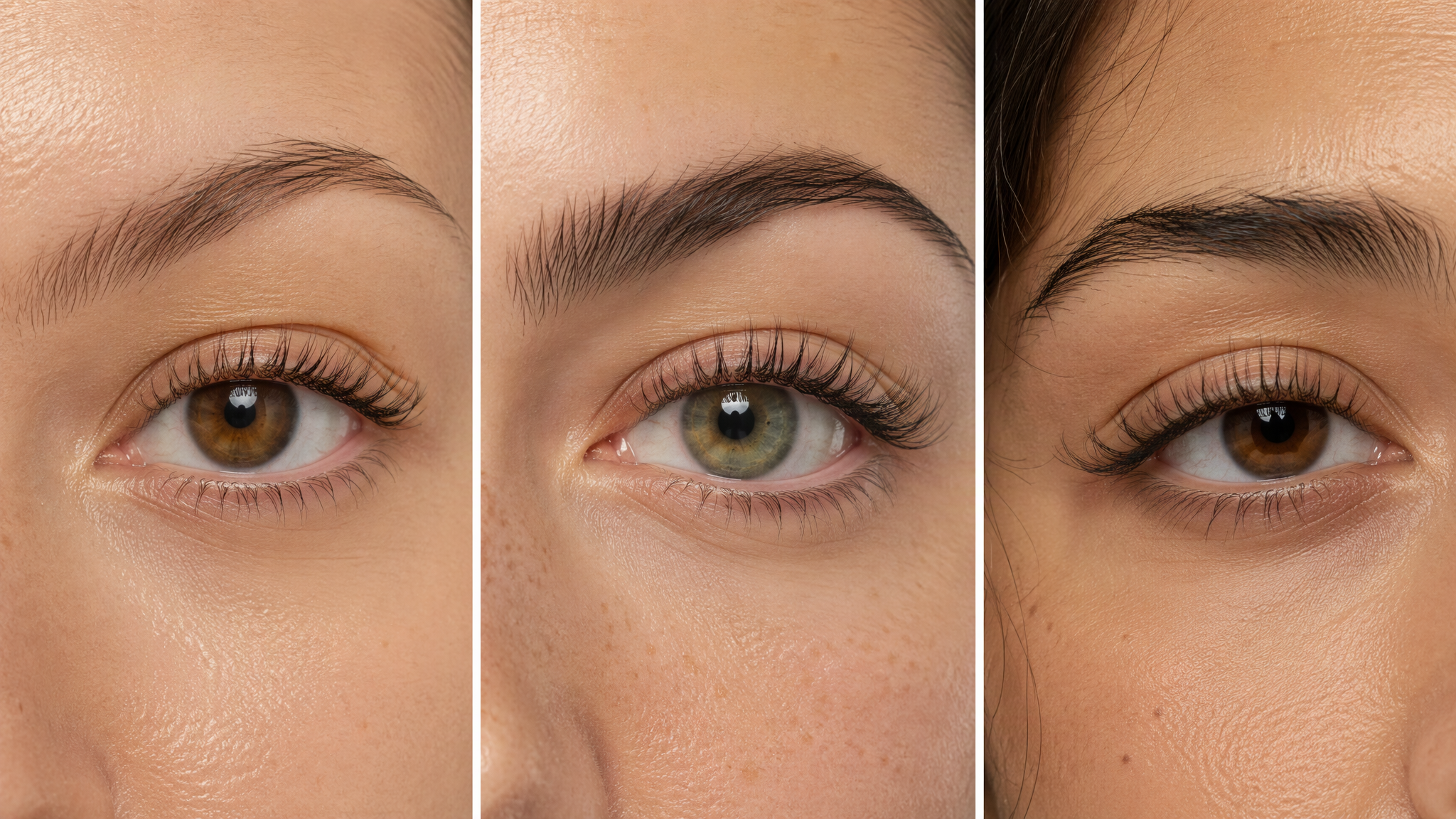
Two clients can ask for “natural lashes” and mean completely different things. One wants an invisible refinement. Another wants a soft, fluttery texture that replaces eye makeup. A third wants an undone, lived-in look with deliberate gaps.
Those are not three skill levels. They are three different design languages, and each one is associated with a city that shaped it: Tokyo, Seoul and Paris.
Understanding them is not about collecting trend names. It gives you a shared vocabulary with the client, a faster consultation, and a clearer way to explain why one set suits them and another does not.
Why City Names Became Style Shorthand
Lash styling vocabulary borrows city and country names because the salon culture in those places developed recognizable priorities. “Japanese lash extensions” is widely described as a philosophy of precise, feather-light enhancement rather than maximum coverage.
Used carefully, these labels are useful shorthand. Used carelessly, they become stereotypes. A client’s nationality or ethnicity does not determine which style suits them. Their natural lashes, eye shape, makeup habits and stated preference do.
Treat the three names as design briefs rather than categories of people. A London client may want the Tokyo brief. A Tokyo client may want the Paris brief.
It also helps to be honest about overlap. All three use the same underlying techniques: classic single-lash application, volume fans, hybrid mixes, curl selection and lash mapping. The difference is how those tools are combined and what the finished set is trying to achieve.
Use city labels as a shared design vocabulary, never as an assumption about the person in your chair.
The Tokyo Brief: Refinement Over Coverage
The Tokyo approach prioritizes a set that looks like it belongs on the client’s face rather than one that announces itself.
Industry education describes the Japanese method as using ultra-fine fibers with meticulous, individual placement, so the extensions blend into the natural lash line instead of covering it. The intent is enhancement, not transformation.
One founder’s account of speaking at a Tokyo lash event contrasts a common Western habit of aiming for full coverage on every natural lash with a Japanese “less, but better” preference, where sometimes the result is subtle enough that extensions are hard to detect. That same account describes lighter, finer fibers and classic or soft volume sets as the dominant client preference.
Note what this is and is not. It is an industry professional’s observation of salon culture, not a controlled study of outcomes. Treat it as a design philosophy worth borrowing, not as evidence that one method is clinically superior.
In practice, the Tokyo brief usually means: a silhouette that follows the natural growth direction, smooth length transitions without abrupt jumps, visible separation between lashes, and curl chosen so the tips sit comfortably within the client’s lid space.
It suits clients who wear little or no eye makeup, who dislike a visible lash line, and who want their set to read as grooming rather than as a look.
The Tokyo brief delivers definition that disappears into the face rather than sitting on top of it.
The Seoul Brief: Soft Texture That Replaces Makeup
The Seoul brief is the opposite instinct: the lashes themselves should do the work that eyeliner and mascara normally do, without looking heavy.
Commercial beauty education describes the Korean lash look as soft, wispy and natural, with criss-cross texture rather than a solid dark band, and a lightweight feel. The stated goal is “done but not done” — polished, never costumey.
That texture usually comes from length variation. Wispy sets typically use a modest length contrast across the lash line for a feathery, everyday finish, while spike-driven sets use a much more dramatic contrast for a graphic, editorial result. One supplier guide puts everyday wispy contrast at roughly 2 to 3 mm and bold spike contrast at roughly 4 to 6 mm. Those are that brand’s working figures for their own products, not an industry standard.
The same guide notes that longer accent extensions should stay within a few millimetres of the surrounding lashes on fine natural lashes, and that a strong curl is often needed for accent lengths to remain visible at all. Again, treat these as practical supplier guidance, not as safety limits.
Be careful not to merge this with manga or anime lash styling. Education sources describe those as a separate, spikier, doll-like effect built on deliberate peaks and valleys. A client asking for a soft Korean flutter and a client asking for anime spikes want different sets.
The Seoul brief suits clients who want visible lash presence on a bare face, who photograph themselves often, and who would rather skip eye makeup than add to it.
The Seoul brief uses texture and length variation to replace eye makeup, not to add weight.
The Paris Brief: Deliberately Undone
The Paris brief is the least codified of the three and the easiest to execute badly.
Where Tokyo seeks invisible precision and Seoul seeks soft texture, the Paris brief seeks a set that looks unplanned. That means accepting irregularity: uneven lengths, sections left lighter, an outline that is not perfectly symmetrical, and curl that reads relaxed rather than lifted.
I should be direct about the evidence here: unlike “Japanese” and “Korean”, I did not find professional education sources defining a standardized “French” or “Parisian” lash technique during this research. The sources reviewed cover curl, mapping, wispy and spike construction, and the Japanese philosophy, but not a documented Paris method.
So treat this section as an editorial design direction rather than a named industry technique. It describes a real client request — “I want it to look like I woke up like this, not like I had it done” — using tools that are documented.
Those tools exist. Textured, non-uniform sets built from mixed lengths and curls are widely described as the current direction in lash styling, moving away from uniform density. Mapping guidance also recognizes that the longest point does not have to sit at the outer corner; a squirrel map, for example, peaks slightly before the outer corner specifically to avoid a downward pull on certain eye shapes.
The practical risk is obvious. “Undone” is not the same as careless. Irregularity has to be designed: you still isolate properly, still select diameters the natural lash can carry, still keep both eyes coherent as a pair. An asymmetric set that was planned looks relaxed. One that was rushed just looks uneven.
The Paris brief is planned irregularity, which takes more control than a uniform set, not less.
Lash Mapping Is What Actually Delivers the Style
City names describe intent. Mapping is how intent becomes a set.
Standard maps are well documented in professional education: classic maps increase length gradually toward the outer corner; doll-eye maps place the longest lengths through the centre to open the eye; cat-eye maps push length toward the outer corner; squirrel maps peak just before it; open-eye maps concentrate length across the centre and inner section; and wispy or Kim K maps place longer spikes at intervals over a shorter base.
Mapping guidance also emphasizes checking symmetry from multiple angles, assessing natural lash health before choosing lengths, mixing curls within one set for a custom result, and not overloading fine lashes with heavy diameters.
This is where the three briefs become concrete. A Tokyo brief typically lands on a smooth, gradual map with restrained lengths and no dramatic peaks. A Seoul brief usually needs a textured map with intentional length variation. A Paris brief needs a map that distributes emphasis unevenly on purpose while keeping the pair coherent.
The lengths and curls themselves are not fixed by the style name. They are set by what the client’s natural lashes can carry and how the eye looks open, not closed on the pad.
Choose the map from the client’s lashes and eye shape; let the style brief guide emphasis, not millimetres.
Using Style Language in the Consultation
The practical value of these three briefs is conversational. Most clients cannot specify curl and diameter, but almost all of them can react to a described outcome.
Try framing the choice around intent rather than product:
•Do you want this to look like nothing was added, or clearly visible?
•Would you rather skip eye makeup, or still wear it over the top?
•Do you prefer a neat, even outline or a softer, less regular one?
•Where did a previous set feel wrong — too heavy, too dark, too long, or too uniform?
•Do you want it to read the same in photos as in person?
Then translate. A client who wants nothing visible and wears no makeup is describing the Tokyo brief. A client who wants to stop wearing mascara is describing the Seoul brief. A client who dislikes anything that looks “done” is describing the Paris brief.
Record the map, curl range, lengths, diameters and colour you used, along with the brief you agreed. That record is what makes the next appointment a refinement instead of a restart.
A style name is only useful if it ends in a written, repeatable specification.
Where Style Choice Stops and Safety Begins
Style discussion is aesthetic. It does not replace eye-health precautions, and it should never be used to justify a set the natural lashes cannot support.
The FDA treats false eyelashes, eyelash extensions and their adhesives as cosmetic products subject to cosmetic safety and labelling requirements, and notes that the eyelids are delicate, so an allergic reaction, irritation or other injury in the eye area can be particularly troublesome. Its guidance advises stopping use of any eye cosmetic that causes irritation and seeing a doctor if irritation persists, and avoiding eye cosmetics when an eye is infected or the surrounding skin is inflamed.
That boundary applies identically across all three briefs. A lighter Tokyo-style set is not automatically safe, and a textured set is not automatically risky. Suitability depends on the individual natural lash, the diameter and length applied, the isolation, and the client’s own sensitivity history — not on the style label.
No aesthetic brief overrides isolation, appropriate load, or a client’s reaction history.
The Takeaway: Three Briefs, One Discipline
Tokyo, Seoul and Paris describe three legitimate answers to the same question: what should this set be trying to do?
Tokyo answers with refinement that hides itself. Seoul answers with soft texture that replaces makeup. Paris answers with deliberate irregularity. None is more advanced than the others, and none suits every client.
The discipline underneath all three is identical. Assess the natural lashes. Agree the intended outcome in plain language. Build a map that serves it. Stay inside what the lashes can carry. Write down what you did.
Fluency in several style languages is useful; fluency in assessment is what makes any of them work.