How restraint became the ultimate luxury — and the smartest repositioning in the business
For the better part of a decade, the lash industry ran on addition. More fans. More length. More density. More drama. Volume sets climbed from 3D to 5D to 10D and beyond, and “bigger” quietly became the default definition of “better”. Clients asked for maximum. Artists delivered maximum. Everyone assumed the ceiling had not been reached yet.
Then 2026 arrived — and the ceiling turned out to be the wrong direction entirely.
The global aesthetic has flipped. The era of stacked, sculpted, unmistakably applied lashes is closing, and what is replacing it is quieter, cleaner and far more demanding: Less is More.
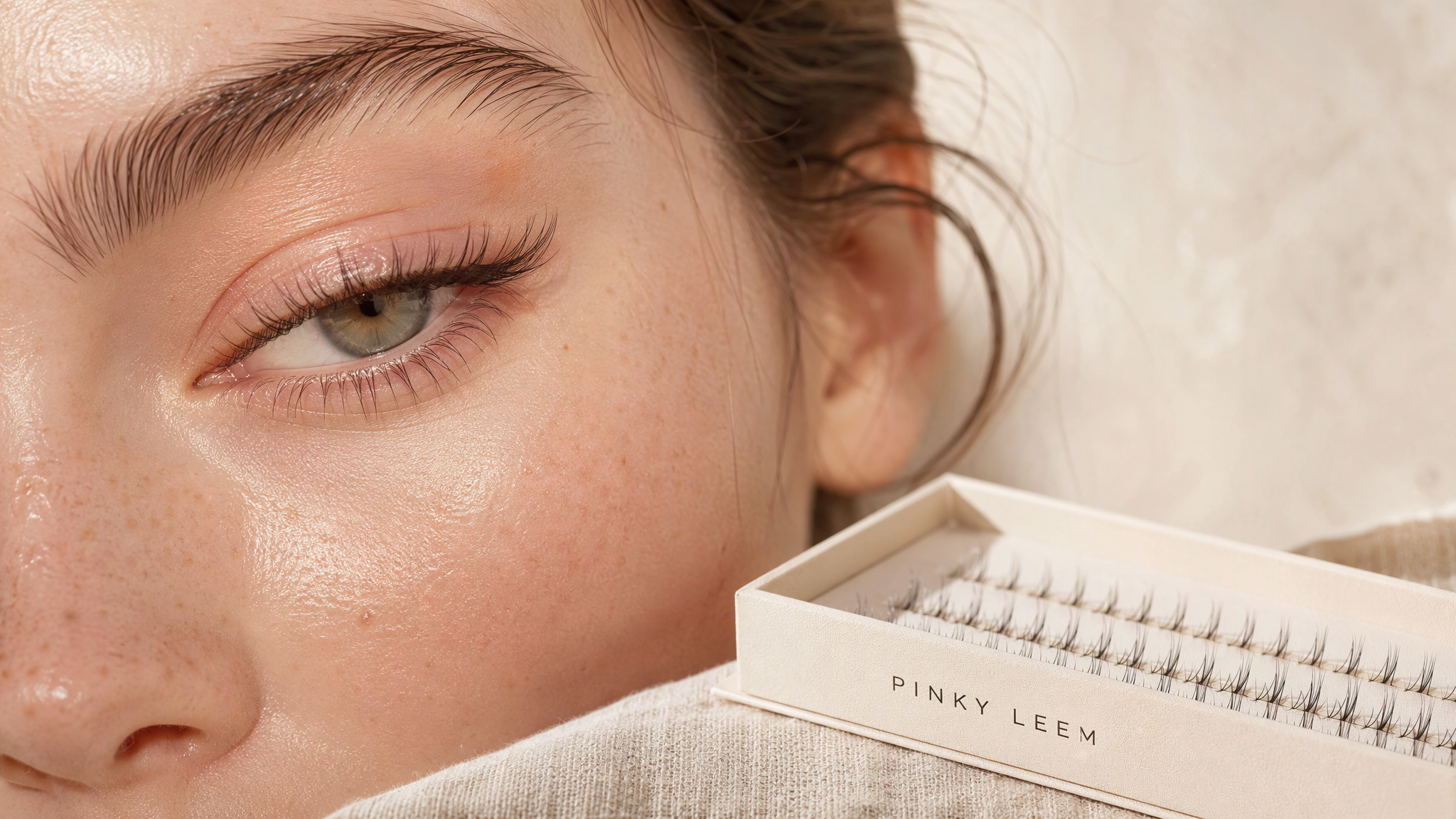
This is not a retreat into bare lashes. It is a shift in what skill looks like. Instead of masking the eye with weight, the new standard is a precise, light, transparent design that amplifies the eye that was already there. The most expensive-looking work in 2026 is the work a client’s friends cannot quite identify as work.
Real luxury stopped being “obviously done”. It became “naturally better”.
1. Why Heavy Lashes Lost Their Grip
Ultra-dense sets and heavy volume fans are not disappearing because they were badly made. They are losing ground because the life around them changed.
The aesthetic moved first
The mainstream eye has moved away from the instantly-readable “influencer finish” and toward the Clean Girl register — skin that looks like skin, brows that look brushed rather than drawn, lashes that read as density rather than as product. Call it quiet luxury, call it low-effort polish; the visual language is the same. Clean, relaxed, low-interference, native.
A heavy set works against that language. It compresses the eyelid, flattens the brow-to-lash proportion and adds visual weight exactly where the current face is trying to look lighter. It photographs as “done”. In daylight, at a desk, at the school gate, on a no-makeup morning, “done” is the one thing clients no longer want to be.
The comfort argument caught up
The second shift is physical, and it is the one that changes retention.
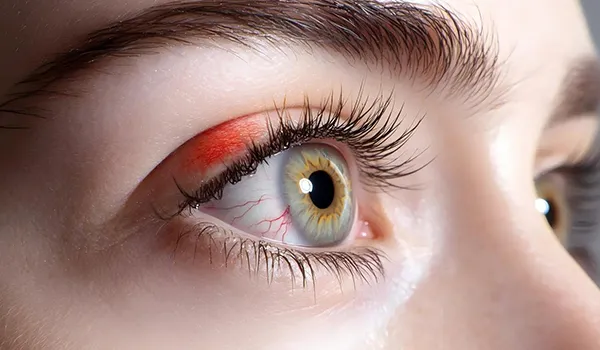
A dense set is heavy. It occludes the lash line, traps dust and sebum, and limits airflow across the lid. It requires longer appointments, more adhesive, more isolation time and more correction work. Every extra fan is another bond that can twist, clump or pull as the natural lash cycles through. Clients feel it as tightness, itchiness or that end-of-week heaviness — and they vote with their booking calendar.
What used to be sold as a beauty upgrade started to be experienced as an upkeep cost. That is the moment a trend dies.
The maturity signal
There is a simpler way to read this. Every maturing aesthetic eventually learns to subtract. More decoration is a beginner’s instinct, because decoration is easy to see. Restraint requires judgement: knowing what to remove, what to keep, and where the eye actually needs help.
2026 is the year the lash industry started rewarding that judgement.
2. What “Less” Actually Means: Four Shifts
The most common misreading of minimalist lashes is that they mean sparse, thin, or barely there. The opposite is true. Less is More is an editing discipline — the smallest amount of material that produces the strongest eye.
2.1 Less volume, more negative space
Instead of a uniform wall of fans across the lash line, the 2026 set is built on distributed density: light feathering, delicate spikes, graduated layers, and — critically — gaps that are left alone.
Negative space is the material. It creates separation, so each lash reads as an individual hair rather than as a mass. It lets light through the set. It keeps the lash line visible so the eye still looks like an eye.
In practice this means narrower fans, lower diameters and a mapping that varies placement rather than filling every position. The result is lighter on the lid, cleaner in outline, and dramatically more forgiving on a bare face. The same client who could only wear a heavy set with a full face of makeup can now wear this one to a 7 a.m. meeting.
2.2 Less length, more proportion
The second edit is length.
The 2026 set does not chase maximum millimetres. It chases proportion: lid space, eye width, the distance between brow and lash line, the angle of the outer corner. Length is distributed where it corrects, not where it announces.
That means custom curl and a graduated length map built per client instead of a house standard applied to everyone. Short inner corners, a controlled rise through the middle, a deliberate outer finish that lifts the eye without dragging it down. Nothing competes with the brow. Everything supports the gaze.
Done properly, the effect is not “long lashes”. It is “her eyes look unusually good today”, which is a far more valuable and far more repeatable outcome.
2.3 Fewer styles, more longevity
Trend-driven lash menus rotate fast: the exaggerated cat eye, the stage-ready dramatic, the seasonal novelty set. They are photogenic for six weeks and dated for the next two years. They also fit almost nobody’s actual week.
The minimalist menu is the opposite by design. It is built to be wearable, flattering, low-risk and slow to date — a set that still looks correct in eighteen months because it was never tied to a moment. Fewer signatures, executed better, with the differentiation carried by mapping, curl and finish rather than by novelty.
That is also what makes it a better business asset: a style that does not expire does not need to be re-sold.
2.4 Less application burden, more comfort
The fourth shift is where the aesthetic becomes an experience — and where the right equipment starts to matter.
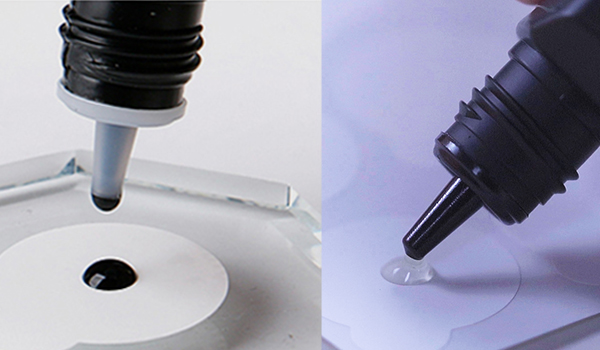
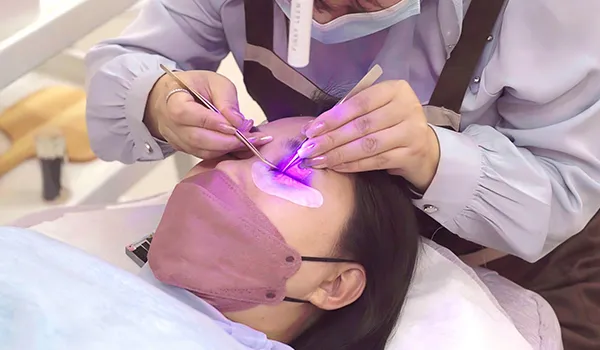
Fewer, lighter fans mean less weight on the natural lash, less pull, less occlusion. Combined with a modern low-irritation UV curing system, the service itself changes: precise placement, instant cure, low odour, no waiting for tack, and a client who can get on with her day — including water — immediately after.
Comfort is not a soft benefit. It is the difference between a client who rebooks on a schedule and a client who “takes a break”. In a market where the set is deliberately subtle, retention has to be earned by how it feels, not by how dramatic it looks.
3. The Business Case: Minimalism Is a Premium Position
For independent artists and small studios, this trend is not just an aesthetic update. It is the cleanest exit from price competition the category has offered in years.
When the product is volume and density, the work is easy to commoditise. More lashes look like more labour, so the market prices by count — and count always gets cheaper somewhere else. When the product is judgement, the comparison breaks down. Two sets can use the same number of lashes and be worth very different amounts, because one was mapped and one was filled.
That asymmetry is the entire margin opportunity.
It filters the client, not just the style
A minimalist signature attracts a specific profile: the client who books in advance, arrives with clean lashes, follows aftercare, and is buying “I look after myself” rather than “I want to look different”. That client is less price-sensitive, less likely to demand a rebuild after ten days, and far more likely to refer people like herself.
It repositions the studio against the discount tier
“Heavy volume, cheap” is a crowded shelf. “Clean, precise, natural — and it lasts” is a narrow one with room at the top. Studios that move early get to own the language before it becomes the default: less is more, editorial lashes, natural volume, invisible set, quiet luxury lashes.
It reduces the cost of every service
Lighter sets mean fewer fans per appointment, shorter chair time, lower product consumption per client, and fewer corrective reworks. Add a UV system with a fast, consistent cure and the schedule tightens further — which, at a fixed hourly rate, is the same thing as a raise.
The premium narrative and the operational saving arrive together. That combination is rare, and it is why this trend is worth acting on now rather than when it is fully mainstream.
4. Running a Studio on Subtraction
The aesthetic logic works on the P&L as well. Good studios do not get better by adding services. They get better by removing what does not earn.
•Subtract inventory. Retire the extreme lengths and the novelty curls that sit in the drawer. Concentrate stock on the diameters, curls and lengths that the minimalist menu actually uses — and buy deeper on fewer SKUs. Less capital tied up, less waste, faster replenishment, and a kit that any artist in the studio can work from without hunting.
•Subtract the menu. A short, well-defined service list makes the consultation faster, the pricing clearer and the training reproducible. When every artist maps the same four or five signatures to the same standard, output stops depending on who is on shift — which is the real bottleneck in most growing studios.
•Subtract the process waste. Standardise the parts that should never vary: patch testing, isolation, mapping notation, cure timing, aftercare script. Then let the artistry live where it actually converts — the design conversation and the finish.
•Add what clients pay a premium for. Mapping expertise. Finish quality. A room that feels calm. A consultation that ends with a client understanding why this set suits her face. A retention standard the studio can actually guarantee. These are the things that justify a higher price and survive a competitor’s discount.
Fewer SKUs, fewer styles, fewer steps. More precision, more consistency, more perceived value. That is the 2026 operating model in one line.
Conclusion: The Hardest Skill Is Knowing What to Leave Out
Beauty at its highest level is white space. Competition at its most exhausting ends in restraint.
2026 does not reward the artist who can add the most. It rewards the one who knows exactly where to stop — who can look at a face, decide what the eye needs, and then resist the urge to keep going.
Less is More is not a compromise, a budget option or a passing micro-trend. It is a higher level of technical control and a more mature commercial position, arriving at the same time. Strip back the excess, return to the eye itself, and let precision do the work that volume used to.
That is where the next few years of lash work are heading.