Why does eyelash extension retention drop drastically when seasons shift, even when your technique, client base, and adhesive remain identical?
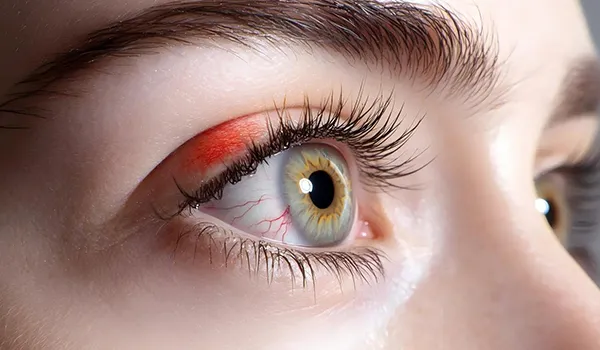
In summer, adhesive dries rapidly, yet clients return within ten days with premature shedding, white frosting, or eye irritation. In winter, that same adhesive becomes sluggish, pulls into sticky strings, slips during placement, and cuts retention in half.
The vast majority of retention failures stem from environmental temperature and humidity mismatches. Eyelash extension adhesives are sensitive cyanoacrylate compounds whose curing mechanism relies on ambient moisture and thermal energy. Summer humidity and winter heating alter viscosity, open time, curing speed, and bond flexibility.
In premium salons, calibrating treatment room climate across seasons is standard operating procedure. Mastering seasonal environmental protocols eliminates client churn, maintains six-week retention, and justifies premium pricing. This guide breaks down the chemistry behind climate shifts and provides actionable salon protocols for year-round retention.
The Golden Environmental Window: Cyanoacrylate Polymerization Chemistry
To solve seasonal volatility, lash artists must understand the chemical reaction powering conventional lash adhesives.
Most professional adhesives contain ethyl cyanoacrylate monomers. Unlike solvent glues that dry through evaporation, cyanoacrylate cures through anionic chain polymerization initiated by ambient moisture. Trace hydroxide ions (^-$) in water vapor trigger liquid monomers to link into rigid polymer chains, forming a permanent mechanical bond around the natural lash cuticle.
The global professional operating baseline for cyanoacrylate lash adhesives is strictly defined:
•Treatment Room Temperature: 20°C to 26°C (68°F to 78°F)
•Treatment Room Relative Humidity (RH): 40% to 60%
Within this baseline, adhesive achieves an ideal equilibrium between viscosity, open time, curing speed, and cured flexibility. The resulting bond is deep black, crystal-clear, lightweight, and resilient against daily friction.
When conditions deviate outside this zone, cyanoacrylate polymerization shifts dramatically. Excessive heat and moisture over-accelerate curing into shock polymerization, while freezing dry air starves the reaction of moisture catalysts. Controlling these dynamics allows salon professionals to manage climate as a precise technical discipline.
Key Section Takeaway: Eyelash extension adhesive cures through moisture-triggered anionic polymerization, requiring a strict 20°C–26°C (68°F–78°F) and 40%–60% relative humidity baseline to achieve full tensile strength without brittleness or incomplete curing.
Summer Hazards: High Heat, Extreme Humidity, and Shock Polymerization
Summer brings elevated temperatures and high relative humidity. While fast curing sounds advantageous, uncontrolled moisture accelerates polymerization beyond placement speed, causing retention failures and aesthetic defects.
•Flash Curing and False Attachment: When humidity exceeds 65%, adhesive droplets polymerize almost instantaneously upon contact with air. A hardened skin forms around the glue bead before wrapping the extension onto the natural lash. This creates false attachment: the extension appears attached, but the liquid core never bonds with the lash cuticle. Within ten days, lash sets brush off cleanly.
•Blooming and Chalky White Residue: High moisture causes shock polymerization, a violent reaction trapping air pockets and disrupting polymer alignment. This manifests as blooming—an unsightly white frosting around the lash base that ruins aesthetics and harbors bacteria.
•Elevated Fume Off-Gassing and Irritation: High temperatures increase cyanoacrylate vapor pressure. Volatile fumes evaporate at higher concentrations, reacting with the tear film to cause stinging, redness, and acute eye sensitivity.
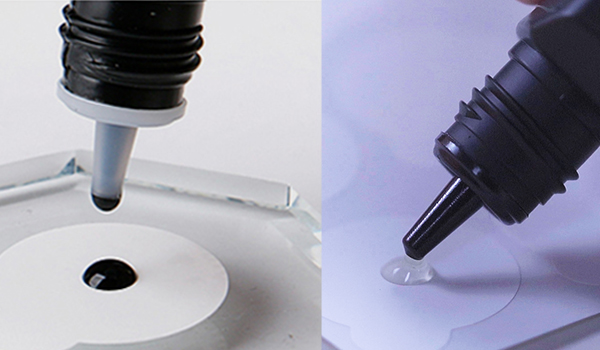
•Adhesive Droplet Degradation: Under hot and humid conditions, droplet lifespan shrinks from thirty minutes to barely ten minutes. The droplet thickens around the perimeter, causing bulky roots and accidental multi-lash sticking.
Key Section Takeaway: Summer heat and high humidity trigger premature surface skinning, shock-cured white blooming, and elevated vapor irritation that undermine lash retention and client comfort.
Summer Action Plan: Salon Dehumidification and Speed Calibration
Conquering summer retention issues requires active dehumidification combined with tactical adjustments to adhesive selection and droplet management.
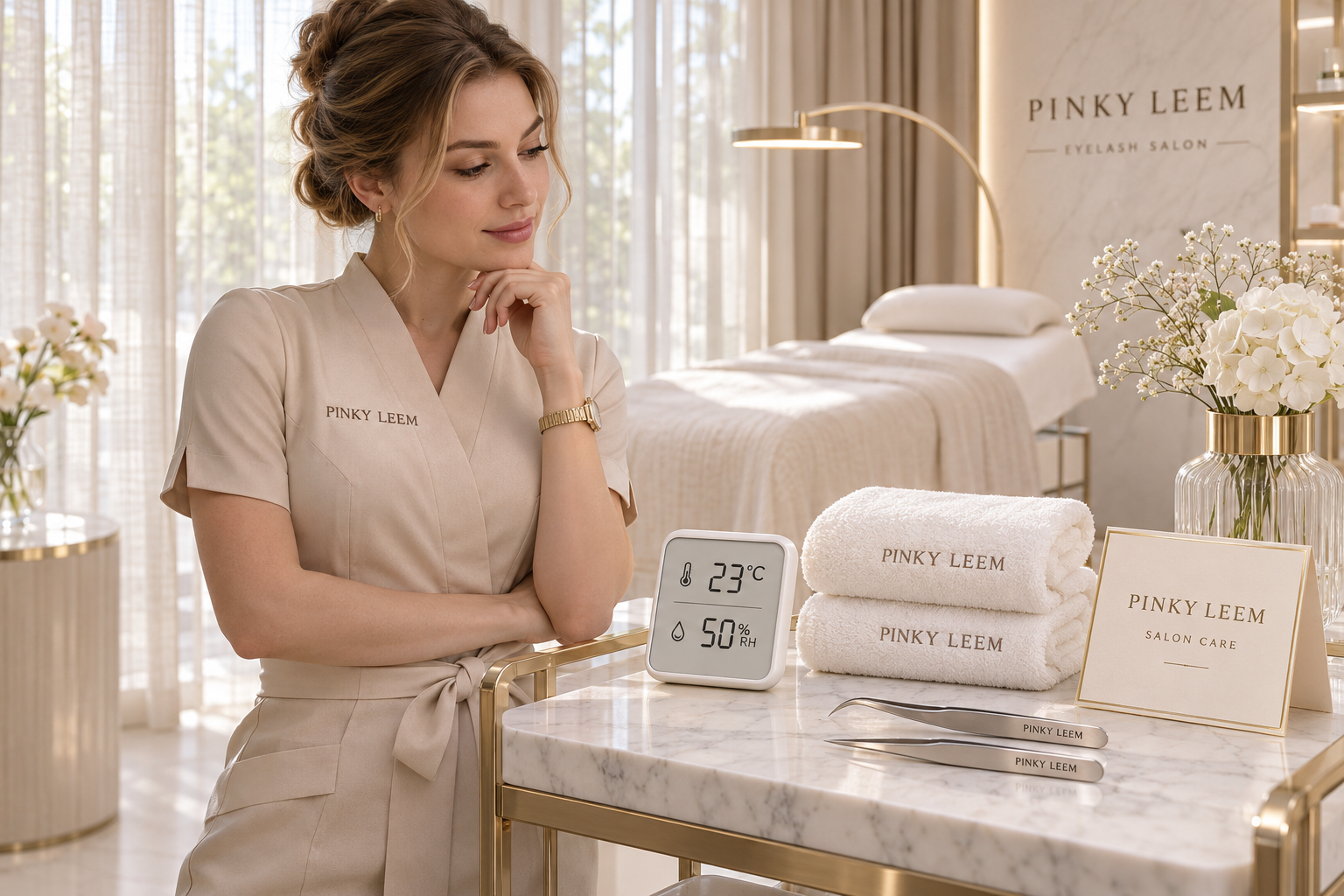
•Environmental Dehumidification: Run a compressor dehumidifier alongside air conditioning to maintain 45% to 55% relative humidity and room temperature between 22°C and 24°C (71°F to 75°F). Monitor climate continuously using a digital thermo-hygrometer at lash-bed height.
•Transitioning to Moderate-Speed Adhesives: If you normally use an ultra-fast 0.5-second adhesive, switch to a 1-second to 2-second adhesive during humid months. Ambient moisture accelerates 1-second glue to 0.5 seconds, providing an adequate placement window.
•Strict Droplet Refresh Cycles: Refresh your glue droplet every fifteen minutes onto a jade stone covered with a disposable foil sticker, which acts as a thermal heat sink. Shake the bottle for sixty seconds, burp the nozzle, and wipe the tip with a lint-free wipe.
•Strategic Ventilation and Nano-Misting: Position a quiet micro-fan near the workstation to draw vapors away from the client without blowing drafts onto open glue. Conclude appointments with a thirty-second nano-mist at thirty centimeters distance for controlled hydration.
•Adhesive Shelf-Life Management: Discard and replace opened adhesive bottles every twenty to twenty-five days during summer, storing unopened backups in an airtight container with silica gel between 15°C and 20°C (59°F to 68°F).
Key Section Takeaway: High-retention summer protocols center on active dehumidification to 50% RH, switching to slightly slower-setting adhesives, refreshing droplets every 15 minutes, and discarding open bottles after 25 days.
Winter Hazards: Low Humidity, Cold Air, and Incomplete Crystallization
Winter presents the opposite extreme: freezing outdoor temperatures and indoor heating that strip moisture from the air. Operating in cold, dry environments starves cyanoacrylate of its essential chemical catalyst.
•Sluggish Polymerization and Lash Shifting: When humidity drops below 35% and room temperature falls below 18°C (64°F), polymerization slows dramatically. A 1-second adhesive may take five seconds to tack. Unpolymerized extensions tilt, slide down the lash shaft, or lean onto neighboring lashes.
•Adhesive Viscosity Spikes and Stringing: Low ambient temperatures cause liquid monomers to thicken. When dipping extensions into cold adhesive, the glue pulls up in long, sticky strings rather than forming a micro-thin coating, leading to heavy glue buildup.
•Incomplete Polymerization and Detachment: In low humidity, cyanoacrylate cannot complete molecular cross-linking. The resulting bond remains semi-solid internally. When the client washes their face or brushes their lashes, the weak bond shears off cleanly, cutting retention by half.
•Mucosal Dehydration and Lingering Fumes: Winter heating dries out client ocular membranes, reducing tear film stability. Because sluggish glue remains wet longer, it releases fumes over hours, causing lingering dryness and bloodshot eyes.
Key Section Takeaway: Winter cold and low humidity cause sluggish curing, adhesive stringiness, incomplete molecular bonding, and prolonged fume exposure that severely shorten lash retention.
Winter Action Plan: Thermal Stabilization and Active Humidification
Overcoming winter retention barriers requires aggressive active humidification, pre-warmed treatment environments, and specialized fast-acting adhesives.
•Pre-Heating and Ultrasonic Humidification: Pre-heat treatment rooms forty-five minutes before appointments, stabilizing temperature between 24°C and 26°C (75°F to 78°F). Run an ultrasonic cool-mist humidifier filled with distilled water to maintain 45% to 55% relative humidity, positioned two meters from the lash bed.
•Adhesive Thermal Acclimatization: Bring glue bottles out of cool storage thirty to forty-five minutes prior to treatment, allowing them to equilibrate naturally to room temperature. Never submerge glue bottles in hot water, which destroys stabilizing agents.
•Upgrading to Fast-Dry Adhesives: In low-humidity winter months, upgrade to a low-viscosity, ultra-fast 0.5-second adhesive formulated with chemical accelerators. Arid air naturally slows the 0.5-second formulation to a comfortable 1-second working speed.
•Eliminating Direct Forced-Air Drafts: Ensure heating vents or space heaters do not blow warm air directly onto the client’s face or adhesive pallet. Direct hot drafts evaporate moisture while skinning the glue surface, leaving a weak liquid core underneath.
•Deliberate Placement Pace: Hold each placed extension with isolation tweezers for half a second longer before moving to the next lash. Allow clients to rest for five minutes after treatment before exiting into freezing outdoor air.
Key Section Takeaway: Winter retention mastery requires pre-heating rooms to 25°C, ultrasonic humidification to 50% RH, allowing glue to reach room temperature before use, and switching to high-reactivity fast-drying adhesives.
Year-Round Operational Discipline: Data-Driven Salon Protocols
Beyond seasonal pivots, elite lash studios implement standardized baseline protocols that safeguard retention regardless of external weather patterns.
•Station-Level Climate Monitoring: Place a digital thermo-hygrometer directly beside your lash pillow at client eye level. Wall-mounted sensors often read two degrees warmer and ten percent drier than the micro-climate at the client’s face.
•Standardized Pre-Treatment Cleansing: Natural sebum and cosmetic oils repel cyanoacrylate. Wash the lash line with an oil-free lash shampoo, rinse with sterile saline, and apply an alcohol-free primer to optimize surface energy.
•Airtight Adhesive Storage: Store all working and backup adhesives upright in an opaque, vacuum-sealed container filled with active silica beads in a temperature-stable cupboard away from direct sunlight.
•Client Seasonal Aftercare Education: In summer, advise clients against swimming, saunas, and oil-based sunscreens for forty-eight hours. In winter, warn against sleeping directly over heating vents or taking scorching hot showers that subject bonds to thermal expansion.
Key Section Takeaway: Installing station-level thermo-hygrometers, standardizing oil-free pre-cleansing, and enforcing strict airtight glue storage form the foundational defense against seasonal retention drops.
The Seasonal Equalizer: LED UV Photopolymerization Systems
While environmental calibration resolves traditional glue challenges, cutting-edge lash salons are adopting professional LED UV eyelash extension systems to eliminate weather dependence.
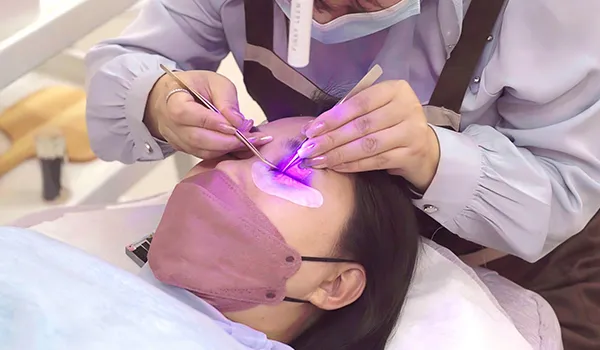
Traditional cyanoacrylate adhesives rely on ambient atmospheric moisture and heat to trigger polymerization over twenty-four to forty-eight hours. In contrast, LED UV lash systems utilize medical-grade photoinitiators activated by a calibrated 395nm low-temperature LED beam. Stepping on the foot pedal for 0.3 to 0.5 seconds cures adhesive to 100% solid cross-linking instantly.
Because LED photopolymerization is light-activated, it operates independently of room temperature and relative humidity:
•Zero Seasonal Sensitivity: Instantaneous curing whether salon humidity is 20% in freezing winter or 85% in sweltering summer.
•Immediate Water and Sweat Resistance: Clients can wash their faces, exercise, swim, and enter saunas immediately without waiting forty-eight hours.
•Elimination of Blooming and Fumes: Instant 0.3-second curing locks volatile monomers instantly, virtually eliminating eye stinging, redness, and white frosting.
•Maximum Operational Efficiency: Artists no longer need seasonal adhesive swapping or noisy dehumidifiers, streamlining salon workflow.
Integrating professional LED UV curing technology provides the ultimate competitive advantage, ensuring unshakeable retention through every seasonal transition.
Key Section Takeaway: LED UV 395nm photopolymerization cures adhesive instantly via light activation in 0.3 seconds, rendering retention completely immune to seasonal temperature and humidity fluctuations.
Conclusion: Elevating Salon Profitability Through Environmental Mastery
In an increasingly competitive beauty market, exceptional lash artistry is only half the equation for commercial success. Flawless mapping attracts clients for their first appointment, but consistent, long-lasting retention keeps their calendars booked year after year.
Lash artists who master treatment room environmental physics elevate themselves from service providers into trusted technical authorities. By understanding cyanoacrylate polymerization, deploying seasonal climate control protocols, and embracing innovative curing technologies, your studio can deliver unshakeable six-week retention in every season. Control your environment, protect client relationships, and watch salon profitability thrive all year long.
Key Section Takeaway: Environmental mastery transforms seasonal retention volatility into predictable six-week client retention, establishing your salon as an elite, high-retention industry leader.