A client books in, mentions that her eyes streamed through her last appointment, and asks whether your UV adhesive will fix it. The honest answer is more useful than the easy one, and it also happens to be better for your retention rates.
Light-cured adhesive does change something real about the sensitive-client experience. It does not change everything. Knowing which is which protects your clients, protects your insurance position, and stops you promising an outcome you cannot control.
Irritation and allergy are not the same problem
This distinction does more work than any product claim, and most salon conversations skip it entirely.
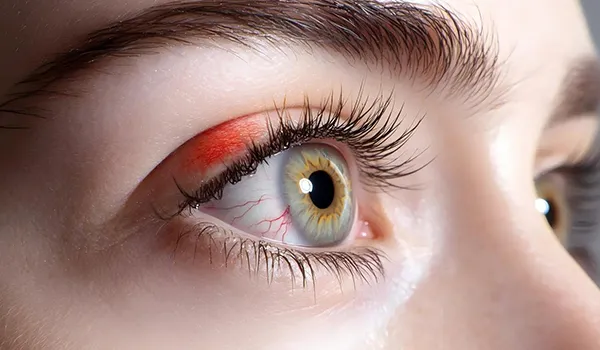
Irritation is a chemical-exposure response. It happens during or immediately after the appointment. The eyes water, sting, feel hot, and the reaction is usually confined to the eye that received more exposure. It is driven by fumes reaching the eye surface, by adhesive sitting too close to the lid, or by too much product in a poorly ventilated room. Irritation is a physics-and-technique problem.
Allergy is an immune response. It typically appears hours to days after the appointment, affects both eyes roughly equally, and comes back worse on each subsequent exposure. It is not caused by fume volume. It is caused by the body recognising a specific molecule and mounting a reaction to it.
The reason this matters commercially: light-cured adhesive meaningfully reduces the first problem and does not remove the second.
What the light actually does?
Conventional lash adhesive is ethyl cyanoacrylate. It cures by reacting with ambient moisture, which is why humidity and temperature control dominate traditional lash training. While it cures, it releases volatile compounds, and that off-gassing is what clients describe as the burning smell.
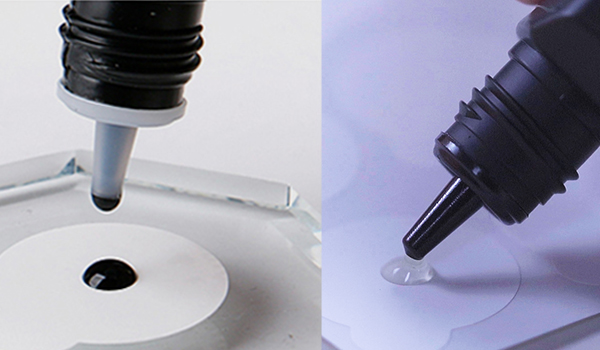
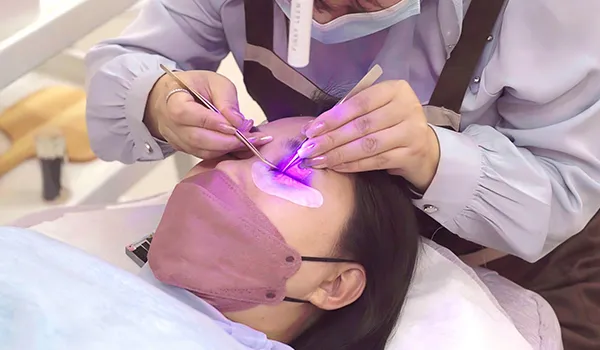
Light-cured systems add photoinitiators. When light at the matched wavelength hits the adhesive, polymerisation starts on command instead of waiting for moisture to do the work. The bond sets in a controlled window rather than over an extended period at the lash line.
The practical consequence is a shorter off-gassing window. Less time spent curing in open air near the eye means less volatile material reaching the eye surface during the appointment. For a client whose problem is streaming eyes in the chair, that is a genuine improvement, and it is the improvement most clients are actually describing when they say a product “worked” for them.
Faster, more controlled curing reduces exposure time — that is the mechanism, and it is worth selling honestly.
Why the allergy risk does not disappear
Here is the part the category markets badly. Light-cured lash adhesives still contain cyanoacrylate, and cyanoacrylate is the molecule most commonly implicated in lash adhesive sensitisation. Industry sources are consistent on this point: UV adhesive “can still contain ingredients such as cyanoacrylate, so it is not guaranteed to prevent an allergic reaction”, and more bluntly, “UV glues still contain cyanoacrylate. They are not reaction-proof. They may reduce risk, but they don’t eliminate”.
A client with a true acrylate-family sensitivity can react to a light-cured product even when it cures cleanly and quickly. Curing speed changes exposure duration. It does not change what the molecule is.
There is a second reason to be careful with the word “hypoallergenic”: it is not a regulated guarantee. A product can carry that label and still trigger a reaction in an individual client, because sensitisation is specific to the person rather than to the marketing claim.
If a client has reacted to lash adhesive before, light curing is a risk reduction, never a clearance.
Ingredients worth understanding
Several components turn up repeatedly in reaction discussions, and a professional should be able to name them.
Cyanoacrylate is the primary bonding agent in most lash adhesives and the most frequent cause of both irritation and allergic response. Carbon black gives adhesive its colour and can cause irritation in clients with pigment sensitivities — clear adhesives exist specifically for this group. Latex appears in some formulations for flexibility and is a known allergen worth asking about during consultation. Formaldehyde is heavily regulated and not deliberately added, but trace amounts can be present as a by-product in some adhesives.
Low-irritation formulation work in the wider adhesive industry focuses on the monomers used to adjust viscosity, selecting those with a low Primary Irritation Index and removing known sensitisers such as isobornyl acrylate. That work is real, and it informs how better lash products get built.
What it does not do is transfer automatically. Adhesives engineered for consumer electronics assembly — optical alignment and lens positioning inside wearables — are designed for skin contact through a device housing, not for application at the lash line of an open eye. A specification sheet from an industrial product line is not evidence about an eye-area cosmetic.
What certification marks really tell you
This is where a lot of lash marketing overreaches, and buyers increasingly know it.
RoHS restricts specified hazardous substances in materials. It is a materials-compliance mark. It says nothing about whether a formulation is comfortable against the eye.
CPNP is the EU’s Cosmetic Products Notification Portal. Notification is mandatory before a cosmetic product is placed on the EU market, and it is a genuine regulatory obligation. But the EU operates no pre-approval system for cosmetics. Notification means the product has been registered with the required information and that a responsible person, product information file, and safety report exist. It is not an approval, and presenting it as one misdescribes how the regulation works.
The FDA point is the sharpest one. The FDA does not approve cosmetics the way it approves pharmaceuticals; cosmetics are regulated under a different framework with no pre-market approval step. “FDA approved” or “FDA certified” on an eye-area cosmetic is not a credential — in the US market it is a claim that invites trouble.
Marks describe what was checked. Ask which claim each one actually supports before repeating it to a client.
How to evaluate an adhesive properly
Request the safety data sheet. If a supplier will not provide full ingredient disclosure for a product you are applying millimetres from a client’s eye, that is the answer to your question.
Treat “odourless” as separate from “low irritation”. Low odour is a real benefit of faster curing, but some products achieve a pleasant smell through masking agents rather than through reduced volatiles. A quieter product is not automatically a gentler one.
Check that your lamp and adhesive are a matched system. Light-cured adhesive needs the wavelength its photoinitiator is formulated for, commonly in the 395–405 nm range, and it needs adequate exposure time. Under-cured adhesive is the worst of both worlds: it keeps releasing volatiles after the appointment while delivering a weaker bond.
Patch test, and schedule it properly. Apply a small number of extensions with the exact adhesive you intend to use, 24 to 48 hours ahead, positioned at the outer corner rather than directly against the skin. Patch testing is not infallible, but it meaningfully reduces the chance of discovering a problem mid-appointment.
Due diligence takes one consultation and prevents the appointment you will be talking about for months.
Protocol for sensitive clients
Ventilation still matters. A faster cure shortens the off-gassing window; it does not eliminate it. Keep air moving.
Keep the adhesive off the skin. Most chemical burns trace back to product placed too close to the lid or applied in excess, not to the product being defective. Isolation discipline is a safety practice, not only an aesthetic one.
Keep the client’s eyes properly closed and covered for the full appointment. Fumes reaching an open or partially open eye is the single most avoidable cause of in-chair streaming.
Know the escalation point. Severe swelling, intense pain, spreading hives, or any change in vision means stop, remove, and refer to a doctor. A small number of clients will react to a well-chosen product, and professional judgement belongs to a clinician at that point, not to a lash artist.
A protocol you follow every time is worth more than any claim printed on a bottle.
Why we would rather say this plainly
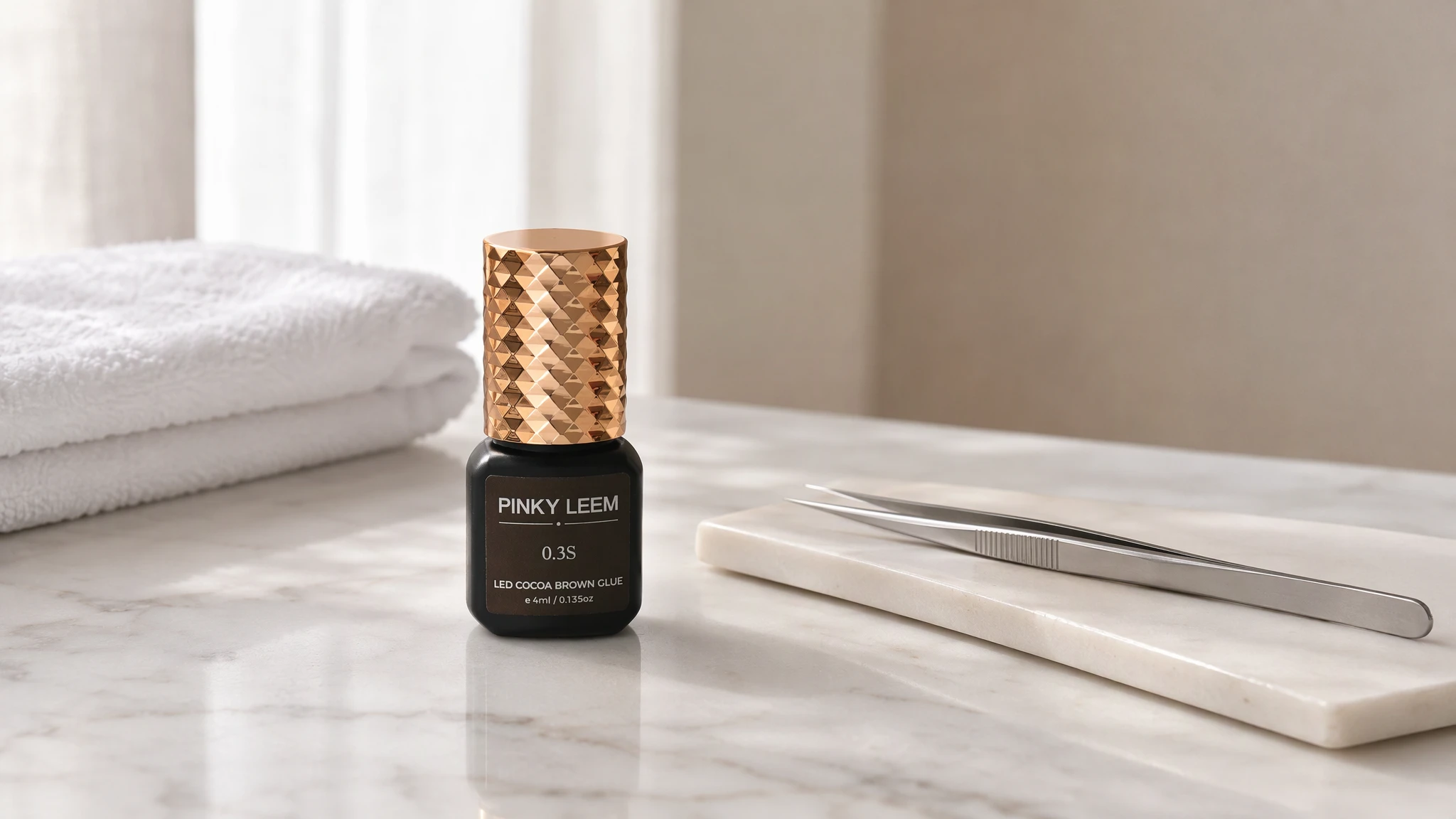
PINKY LEEM manufactures light-cured lash adhesive. It would be commercially convenient to let the category’s language stand and let clients assume the allergy problem is solved.
We would rather be the supplier you can quote. When a client asks whether your new adhesive means she will not react, you need an answer that holds up if she researches it afterwards — and the honest answer is specific: the curing window is shorter, the exposure time at the lash line is lower, and the experience in the chair is usually more comfortable. If she has a diagnosed acrylate sensitivity, the molecule is still present and she should patch test with your actual product before committing to a full set.
That answer keeps a client. The other answer loses one, publicly, three days later.
The suppliers worth keeping are the ones willing to name the limits of their own product category.
The part that is genuinely better
None of this cancels what light-cured adhesive improves. For the large group of clients whose problem is in-chair irritation rather than immune sensitisation — streaming eyes, stinging, the smell they brace for — a shorter and more controlled cure is a real upgrade to the appointment. That is most of the people who describe themselves as sensitive.
The technology solves an exposure problem. It is worth adopting for exactly that reason, and worth describing in exactly those terms.
Sell the improvement you can actually deliver, and your sensitive clients will trust the rest of what you tell them.