She sits down in the chair, looks in the mirror and says the same thing the last three clients said: “My left eye is smaller than my right. Can lash extensions even help with that?”
Or the photographic version: “I only ever smile on one side, because the other eye looks asleep.”
The answer is yes — and not for the reason most people expect. Extensions will not make the two eyes identical. What they do is change where the eye travels across a face, and that is the lever asymmetry actually responds to.
01 — Nobody’s Face Is Symmetric
Start with the fact that removes most of the anxiety: human faces are not symmetrical, and never have been. The difference between left and right is a normal product of genetics, chewing habits, sleeping position and years of expression. A face that measured perfectly identical on both sides would not read as beautiful. It would read as uncanny.
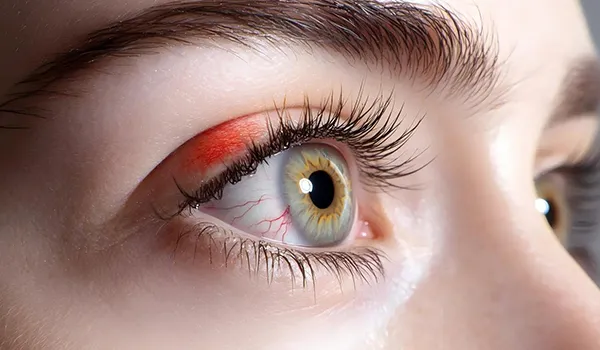
What shows up around the eyes comes in a small number of recurring patterns. The lid structure can differ — a double fold on one side, a monolid or hooded fold on the other, or one eye sitting rounder while its partner reads longer. The brow-to-eye distance can differ, with the brow sitting higher above one eye than the other. The eye opening itself can differ, one lid resting marginally lower so that eye looks smaller. Lash growth direction can differ, one side lifting naturally upward while the other grows flat or downward. And the outer corner can sit at a different height on each side, producing a visual tilt that no single product choice causes and no single product choice can blame.
Most of these are invisible to the client until the day she notices them. From that day on, she cannot stop seeing them. That is the real reason she books — not the millimetre of difference, but the fixation on it.
02 — The Design Philosophy: Balance, Not Correction
A good lash artist is not hiding anything. The job is the same one a good hairdresser takes on: design *with* the shape you were given, not against it.
Custom lash design respects the eye as it is and works on three variables — density, length and curl — to move the viewer’s attention where the artist wants it to land. Nothing is “fixed.” The two eyes simply stop competing with each other.
Two habits matter more than any product choice. The first is to treat the two eyes as two separate maps rather than one order form: symmetry on paper is not the goal, symmetry in the mirror is, and a 12 mm lash is not the same lash on two different eyes. The second is to expect the change to be tiny. The whole result often rests on one to two millimetres of length and a few degrees of curl. If a client asks what you did, “nothing much” is technically accurate — and it is also the entire craft.
03 — Five Asymmetries, Five Design Responses
This is working reference, not theory, and each pattern gets a different answer.
Where one eye is a monolid or a hooded fold and the other carries a clean double fold, the flat side gains density and length so it develops real presence, while the double-fold side is left natural. The two eyes then read at equal weight instead of one outweighing the other.
Where one eye simply looks smaller, the work goes into the centre of that eye — added length and a stronger curl through the middle third. The eye opening looks wider as a result, without anything at all being done to the lid itself.
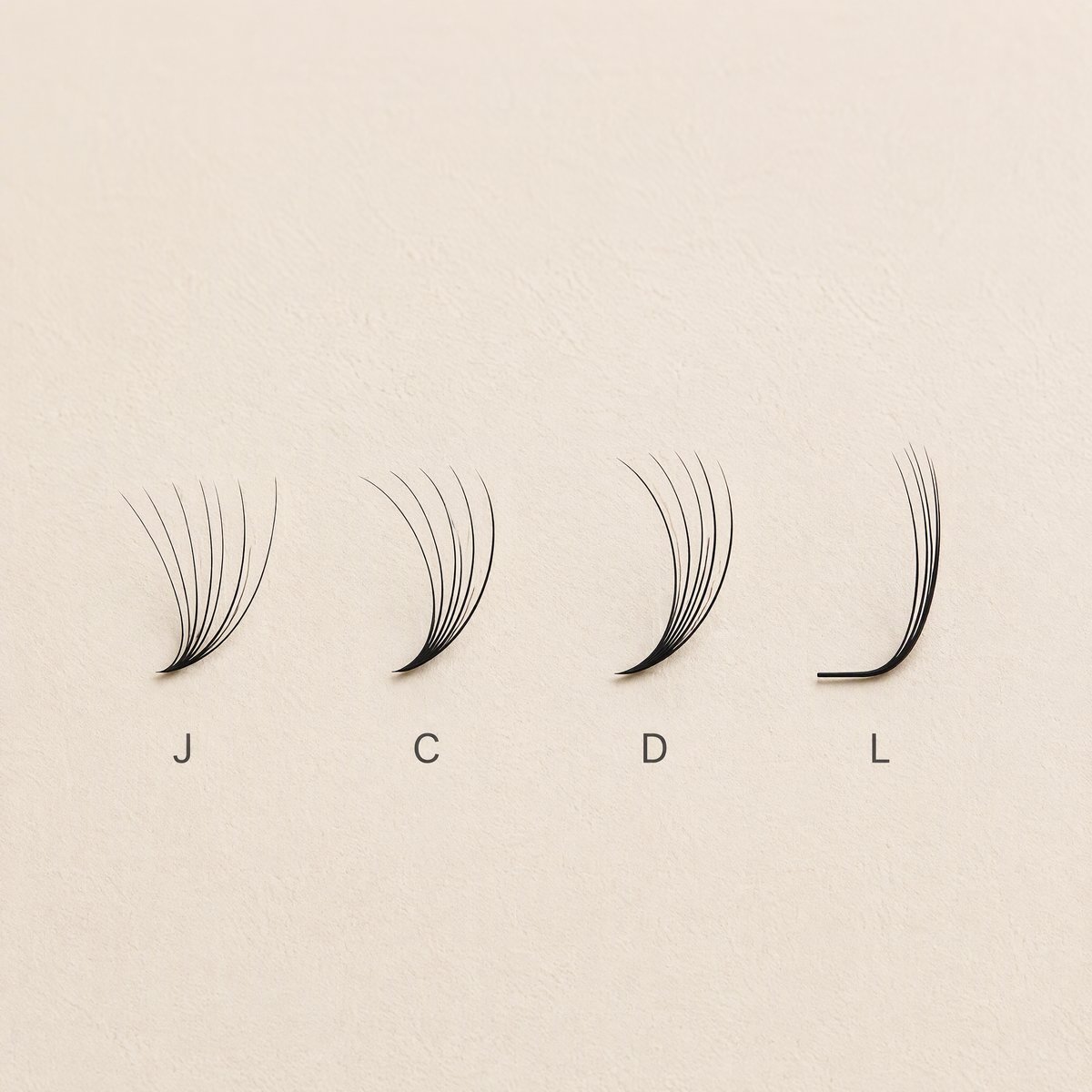
Where the brow sits close to the eye on one side, curl does the separating. A C curl opens modest space; an L curl, with its flattened base, opens the most. On the side where the brow already sits high, a natural curl keeps the two lids feeling like siblings.
Where the outer corner droops on one side, length and lift are carried into the tail on that side, so the corner reads as lifted rather than pulled down. This is the adjustment most likely to be noticed by the client herself, because it is the one she has been trying to draw around with eyeliner for years.
And where one eye reads round while the other reads long, the round eye is lengthened toward its tail while the long eye is built out through its centre. Neither eye moves toward a third shape; they converge on each other.
The important word in every one of those five paragraphs is *reads*. This is visual work. Promising anything structural is how a beautiful set turns into a disappointed client.
04 — Three In-Studio Examples
The hooded right eye. A client with a clean double fold on the left and an inner fold that collapsed over the lash line on the right, spending ten minutes every morning on tape. The right eye received a fuller, curlier C+ lash with extra density through the centre, giving that lid line something to sit against; the left eye received a lighter JC curl, one step shorter. The result was not two identical eyes. It was an inner-fold eye that suddenly looked awake and a double-fold eye that no longer looked overdone. She stopped rotating her head for photographs.
The tired side. A professional client in her thirties whose right eye had begun to sit slightly smaller after years of screen work, with a lid that had relaxed a little over time. The right eye took lash two millimetres longer through the centre at higher density; the left eye was kept deliberately light so it would not pull attention. Both sides went to D curl, so the direction of lift matched. Her note afterwards was the one every artist wants: she could look straight into a camera without angling her face.
The uneven brow gap. A client born with a wide brow-to-eye distance on the left and a narrow one on the right, and no idea where to stop drawing her brows. The right side received L curl, which flattens at the base and opens the vertical space; the left received a natural C curl with slightly more density to hold its own against the wider gap. Two different lashes, one proportion.
05 — The Numbers Behind the Design
The reason a custom map can be repeated by a second artist is that it was never guesswork.
Length is graded rather than uniform: longer where the eye needs to be opened up, shorter where it needs to recede. The difference between the two eyes is regularly only one to two millimetres, and that is precisely what makes it look like nothing was done at all.
Curl does most of the structural talking, and it helps to have one shared vocabulary for it. A J curl lifts around thirty degrees — a barely visible upward sweep, which is exactly what a narrow brow gap needs, because anything stronger crowds the lid. A C curl reaches roughly forty-five degrees and is the everyday opening lift, the safe choice wherever the brow-to-eye distance is average. A D curl goes further again, toward fifty-five degrees, with enough visual impact to help a wide gap or to give a tired-looking lid real direction. The L curl is the specialist: around sixty degrees, but with a flat section at the base that stands the lash away before it curves, which is why it separates a low brow from the lash line more effectively than any stronger curl does, and why monolid and hooded eyes are usually its biggest users.
Two honest cautions belong in this paragraph. Those degree values are Pinky Leem’s working reference, not an industry standard — different suppliers label the same lash differently, and degrees never travel between brands. And if a client genuinely has ptosis, a lid that droops for structural rather than cosmetic reasons, extensions are a cosmetic decision and not a treatment. A good artist says that out loud, writes down what she observed, and works conservatively on a lax lid rather than loading it with weight.
Thickness completes the picture, running from 0.05 mm to 0.20 mm and controlling how present the lash line feels. Slightly thicker on the side that needs to hold attention, finer on the side that should stay quiet.
06 — Four Mistakes That Make Asymmetry Worse
Mapping both eyes from one order form. The most common failure, and the easiest to explain to a client afterwards: identical lengths on non-identical eyes produce a mirrored result on a face that is not mirrored.
Adding weight instead of shape. The instinct on the weaker eye is to pile on density. Fine native lashes under a heavy fan shed early, so the asymmetry returns at week three — larger than before, and now attributed to your work rather than to her growth cycle.
Designing to a resting face. A set photographed at rest will be worn while talking, laughing and squinting at a screen. Assess the moving version of her face before committing to the tail.
Promising a correction. The client will remember the word you used, not the caveat you attached to it. Say balance, visually, reads as. Never fix.
07 — What a Good Artist Does in the First Ten Minutes
The design is decided before the first lash is isolated, in four passes.
First, static, eyes forward: record the baseline differences in eye opening, lash direction and tail height. Then dynamic: ask her to talk and to smile, because some faces are symmetrical at rest and not in motion, and the set has to survive the moving version. Then chin lifted: observe the growth angle at the root, which is what actually determines how much curl you can get away with. Finally, eyes closed: read the lid shape to decide how the rows should be directed.
Five to ten minutes, no product touched. Clients frequently experience this part as the moment they decided the studio was professional — before a single extension had been placed.
08 — Aftercare That Keeps the Balance
An asymmetric design depends on its small differences, which makes it slightly less forgiving than a uniform map.
Infill every two to three weeks. Uneven growth erases a designed difference faster than it erases a symmetrical one, and losing the pattern is what clients describe as “it looks lopsided again.”
Do not rub or pull. Native lashes on an asymmetric face often grow in opposing directions, and mechanical tugging scrambles them further.
Comb once in the morning and once in the evening with a clean spoolie, following the designed direction rather than whichever direction is easiest at the time.
Never remove at home. Professional removal protects the native lash. Damage it, and the asymmetry she arrived with can end up worse than the day she first sat in the chair.
A lash artist I know puts it this way: there is no such thing as a symmetrical face, any more than there are two identical leaves. The goal was never identical eyes. It is two eyes that stop arguing with each other.
Custom design does not make the left match the right. It gives each of them a different job, until the face as a whole settles into something that reads as calm.
So when you lie back and feel the artist measuring one side against the other, that small pause is the whole service in miniature — a professional deciding which millimetres matter, and quietly agreeing with you that the difference was never a flaw.
Your eyes were already the artwork. The lashes are just the frame.
Published by Pinky Leem — professional lash systems for studios, artists and brands that compete on quality rather than price.
Internal notes — verify before publishing (remove this section)
1. The three cases are the highest-risk item in this article. Your source named them (Ya / Lin / Chen) and described their results. A named client plus a described outcome is a testimonial: in the US the FTC requires a real, typical and consented experience, and EU consumer law treats unconsented or fabricated endorsement as an enforcement matter. All three have been rewritten as unnamed in-studio examples, with no name and no age claim you cannot support, so the section is publishable as it stands. If you want them as genuine testimonials instead, the requirement is written consent per client, before-and-after photos, and the actual service date. Choose one route; do not mix anonymous text with identifiable photos.
2. “Studies show” was removed. Your source opened the anatomy section with research indicates but gave no citation. It is now written as accepted anatomical fact with no reference attached. If you want a link to cite, send me the source and I will add it — never print “studies show” unattached on an English-language site.
3. The relaxed eyelid case sits on a medical boundary. The source said the eye muscles appear slightly relaxed. It is now rendered as “a lid that had relaxed a little over time,” and the ptosis caveat in section 05 was added deliberately. Do not let any later edit imply that extensions improve a medical lid condition; that is the sentence a regulator or a competitor screenshots.
4. Curl degrees are labelled as your spec, not a standard. J / C / D / L at roughly 30-45-55-60 degrees comes from your text and is written as “Pinky Leem’s working reference, not an industry standard.” Suppliers label the same lash differently, and lash artists genuinely argue about this in comments. That clause is the firewall — keep it.
5. Confirm your thickness range. 0.05 mm to 0.20 mm is written as you supplied it. Most brands actually stock 0.05 / 0.07 / 0.10 / 0.15, so check the low and high ends against your live SKUs before this page links to a product.
6. The “visually” framing is deliberate and must stay. Every outcome sentence in this translation says reads, looks or visually. Drop it once and the copy stops being cosmetic and starts being a functional claim.
7. Terminology choice. 一单一双 is rendered as monolid / hooded fold. These are the words English-speaking clients actually type into Google and Instagram search. Do not replace them with clinical phrasing; it costs the page its ranking keyword.
8. Check for keyword cannibalisation before publishing. This page targets lash extensions for asymmetric eyes. If any existing product page already carries that phrase in its title or meta, the two pages will compete with each other. Send me those URLs and I will split the keyword allocation across the site.