UV lash lamps are increasingly used in professional lash studios because light-cured adhesive can be set in short, controlled flashes. At the same time, many clients and lash artists worry that repeated exposure could create fine lines, dark circles, retinal damage, or premature eye aging.
The honest answer is more useful than a simple yes or no: UV exposure can harm skin and eyes when the dose is excessive, but a specific lash lamp cannot be declared harmless—or dangerous—without verified information about its spectrum, irradiance, exposure geometry, shielding, and intended operating procedure. A responsible safety discussion must separate general UV science from product-specific evidence.
This guide explains what the original rumor gets wrong, what remains unknown, and how salons can reduce avoidable exposure without making medical promises.
1. What Does “UV” Mean in a Lash Lamp?
Ultraviolet radiation is invisible electromagnetic radiation between visible light and X-rays. It is commonly divided into UVA, UVB, and UVC. These bands differ in wavelength, penetration, and biological effect. The U.S. Food and Drug Administration notes that UVA and UVB are present in sunlight, while UVC at the Earth’s surface mainly comes from artificial sources because atmospheric ozone blocks solar UVC.
That classification matters, but the label “UV” alone does not tell us whether a lash lamp is safe. Two devices can both be called UV lamps while producing different spectral outputs and different exposure levels. A product photograph also cannot confirm wavelength, optical power, irradiance at the working distance, beam spread, or photobiological safety testing.
The source article describes a working distance of approximately 15–20 cm and curing flashes of 5–10 seconds. Those figures should be treated as operating examples from the source material—not universal safety limits. The correct distance and curing time must come from the lamp and adhesive manufacturers’ instructions, and should not be extended simply because a shorter cycle appears convenient.
2. Myth One: Any UV Flash Automatically Ages the Skin Around the Eyes
UVA and UVB can contribute to skin damage and premature photoaging when exposure is excessive or cumulative. The FDA describes prolonged UV exposure as a cause of premature skin aging, while ophthalmic organizations warn that overexposure can also affect the eye’s surface tissues, cornea, and lens. Those facts apply to UV radiation in general; they do not automatically prove that every lash-lamp session produces a clinically meaningful photoaging dose.
The original article compares one brief lamp exposure with a precise number of seconds outdoors. That comparison should not be retained without a validated measurement of the lamp’s spectral irradiance and a clearly defined sunlight condition. Outdoor UV varies with location, season, time of day, altitude, weather, reflection, and the UV Index. A numerical comparison that ignores those variables can sound scientific while being misleading.
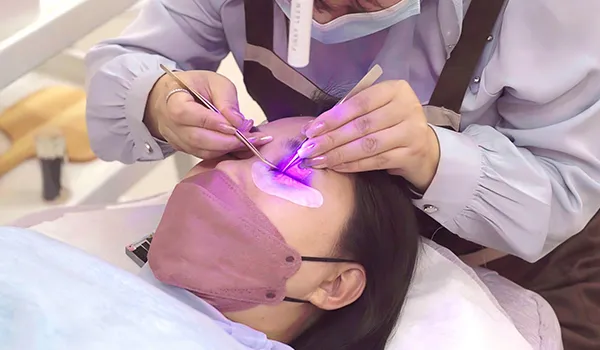
A better explanation is based on exposure geometry. During lash services, the lamp should be positioned to cure the adhesive at the lash area rather than aimed at the client’s face. Distance, angle, beam spread, eyelid position, barriers, and total session time all affect how much radiation reaches surrounding skin. Even so, “brief” does not mean “zero,” and “used near the lashes” does not prove that the eyelid skin receives no UV.
Clients with photosensitivity, a history of eye disease, or medicines and cosmetics that increase UV sensitivity should not rely on a general blog statement. They should discuss the service with an appropriate healthcare professional and tell the lash artist about relevant sensitivities before treatment.
3. Myth Two: The Lamp Will Either Age the Retina or Cause No Eye Risk at All
The eye has natural protective structures. The cornea and lens absorb or attenuate much of the incoming UV before it travels deeper into the eye. However, this is not permission to look directly at an artificial UV source. The American Academy of Ophthalmology and the American Optometric Association both warn that excessive UV exposure can damage eye tissues, and that artificial sources can also create hazards.
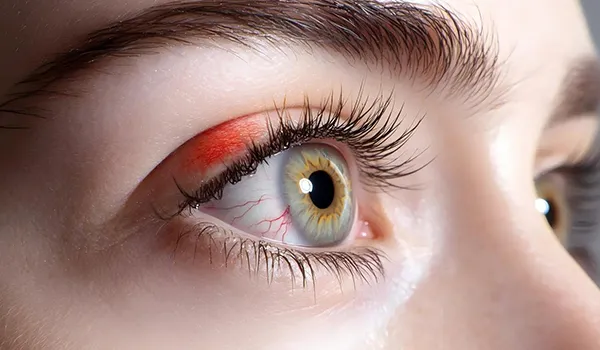
The type of risk depends on the spectrum and dose. Excessive short-term exposure can cause photokeratitis, an eye-surface injury sometimes described as a “sunburn of the eye.” Symptoms may include redness, pain, tearing, light sensitivity, and a gritty or foreign-body sensation. Longer-term cumulative exposure is associated with conditions such as cataracts and other eye problems, although the exact risk for a particular lamp cannot be inferred from its appearance.
Closed eyes reduce direct exposure but are not equivalent to certified eye protection. Eyelids are not an engineered UV shield, and clients may open their eyes unexpectedly or shift position. A lamp that is angled downward is better than one aimed at open eyes, but angle alone is not a substitute for verified shielding, a safe operating procedure, or appropriate protective equipment when the device instructions require it.
The original article states that UVA can hardly reach the retina and that a small amount cannot cause harm. Those absolute statements are too strong. The safer wording is that the eye’s anatomy provides partial protection, while exposure risk still depends on wavelength, intensity, duration, direction, and individual conditions.
4. Myth Three: Every Post-Service Symptom Is Caused by UV
Dryness, redness, stinging, or a foreign-body sensation after lash extensions can have several causes. Adhesive vapors may irritate the ocular surface and surrounding skin. Accidental adhesive contact, tape or pad pressure, prolonged eye closure, poor ventilation, an allergic reaction, or an existing eye condition may also contribute. It is not scientifically sound to assign every symptom to the lamp—or to dismiss every symptom as unrelated to UV.
A client who develops severe pain, marked light sensitivity, reduced vision, swelling, discharge, or symptoms that persist should stop the service and seek medical advice promptly. Artificial tears may be appropriate for some forms of simple dryness, but they are not a diagnosis and should not delay professional care when symptoms are significant.
Aftercare language should also be cautious. Avoid rubbing the eyes, follow the adhesive manufacturer’s instructions, and keep the area clean according to professional guidance. Do not promise that a cosmetic eye essence will prevent inflammation or reverse an exposure injury. Products used near the eye should be selected and applied only according to their intended use.
5. A More Responsible UV Lash-Lamp Safety Routine
Verify the device before the appointment
Ask the supplier for the product’s intended use, spectral information, irradiance or power data where applicable, operating distance, curing instructions, and relevant electrical or photobiological safety documentation. Do not use a generic “low power” label as proof of safety. Do not copy a certification claim from a different market or model.
Follow the lamp-and-adhesive instructions
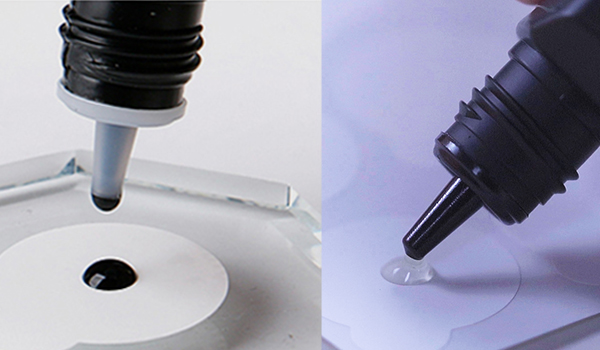
The lamp and the light-curable adhesive form one working system. Use the stated distance, alignment, curing cycle, and compatible adhesive. Do not increase exposure time to compensate for a poorly positioned lamp, an incompatible adhesive, or uncertain curing performance. If the manufacturer has not supplied a parameter, treat it as unknown rather than filling the gap with a guess.
Keep the beam away from open eyes
The client should keep the eyes closed during the service, and the technician should position the lamp so it targets the lash area rather than the eye itself. The technician should explain that the client must report heat, stinging, unusual brightness, pain, or discomfort immediately. Stop the exposure if symptoms occur.
Reduce unnecessary exposure for the technician
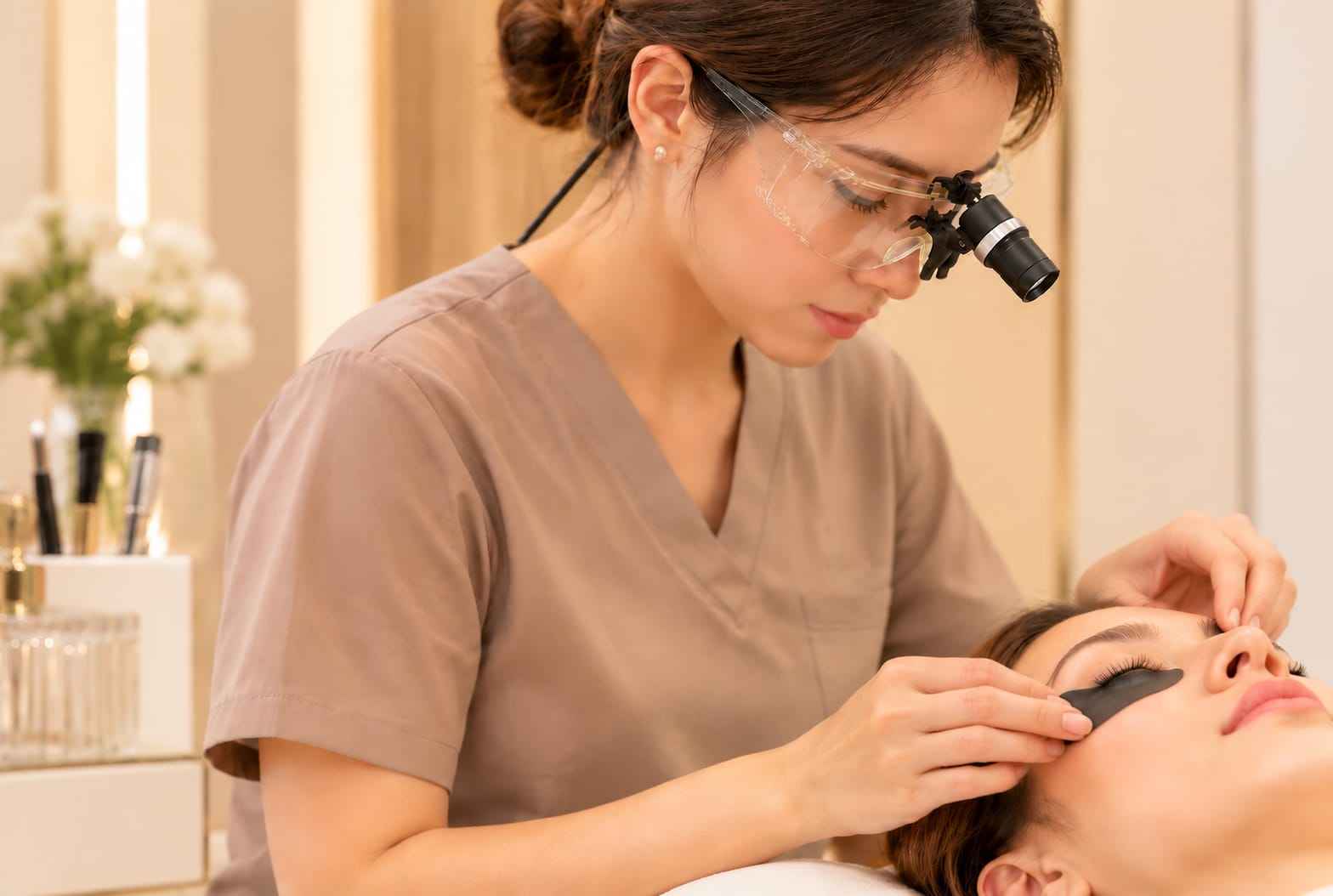
The person operating the lamp may receive more repeated exposure than a single client over a working day. Avoid staring into the source, avoid placing the lamp at face level when it is not needed, and use any shields or protective eyewear specified by the manufacturer or workplace safety guidance. Keep the work area organized so the lamp cannot be knocked into a direct line of sight.
Keep records and improve the process
For professional salons, record the lamp model, adhesive batch, working distance, curing cycle, client reaction, and any corrective action. This helps identify whether a problem is related to positioning, adhesive behavior, ventilation, technique, or the device itself. It also prevents a vague “UV is safe” claim from replacing real process control.
6. Final Answer: Does a UV Lash Lamp Cause Eye Aging?
Current general UV evidence does not justify the blanket statement that every UV lash lamp causes eye aging. It also does not justify the opposite blanket statement that every lash lamp is harmless or that eye aging is impossible. The evidence-based conclusion is conditional: UV can injure skin and eyes when exposure is excessive, while the risk from a particular lash lamp depends on its actual output and how it is used.
For salons and clients, the practical priority is not fear or reassurance without evidence. It is controlled exposure. Use a product with clear instructions and traceable documentation, keep the light away from open eyes, avoid unsupported comparisons with sunlight, and treat persistent eye symptoms as a health issue rather than a marketing problem.
PINKY LEEM supports a professional approach in which beauty technology is discussed with both performance and responsibility in mind. A lamp can be presented as a tool for controlled curing, but no product image or blog article should be used as a substitute for the manufacturer’s technical file, applicable compliance requirements, or medical advice.