Why Refrigerate Eyelash Extension Glue? 90% of People Store It Wrong
“My newly bought eyelash extension glue clumped up after only half a month!” “The glue turned cloudy and is unusable even though it’s unopened!”—If you’ve encountered these problems, you’ve likely overlooked the crucial step of “glue storage.” Many beginners think “eyelash extension glue can just be put in a drawer,” but proper storage (especially refrigeration) directly determines the glue’s lifespan and the extension’s effect. Today, we’ll start by explaining the glue’s composition and principles, telling you why it’s essential to refrigerate it, and providing storage tips for different types of glue to help you avoid wasting money and affecting your extension results.
I. First, understand: What is eyelash extension glue “afraid of”?
To understand why refrigeration is necessary, you must first know what the glue’s core components “afraid of.” Both regular quick-drying adhesives and UV-curing adhesives primarily contain cyanoacrylate (the adhesive component). These components are particularly sensitive to temperature, moisture, and air, and problems easily arise during room temperature storage:
High temperatures: Room temperature (especially above 25°C in summer) accelerates the decomposition of the curing agent. For example, the initiator in regular quick-drying adhesives may become ineffective within 3 days at high temperatures, causing the adhesive to clump instantly upon application to eyelashes, making precise application impossible.
Moisture: Moisture in the air will undergo a hydrolysis reaction with the adhesive components, causing the adhesive to become cloudy, separate, and even develop a sour smell. Such adhesive will have significantly reduced adhesion, and false eyelashes may fall off within 1-2 days.
Air: Once opened, the adhesive will slowly oxidize upon contact with air, not only increasing its viscosity (resulting in a stringy consistency when applied) but also making the cured adhesive layer brittle and prone to breaking with the slightest touch.
The low temperature and low humidity environment of a refrigerator perfectly solves these problems—like preserving the glue, it slows down the deterioration of the ingredients and keeps the glue in its best condition.
II. Why is a refrigerator the “best storage place” for eyelash extension glue? 3 core reasons
Many people think that “only food needs to be refrigerated,” but for eyelash extension glue, refrigeration (2-8℃) is crucial for its longevity, specifically for three core reasons:
1. Low temperature delays hardener failure, extending the glue’s “active period”
The glue’s “adhesive strength” is maintained by the hardener—ordinary quick-drying glues require a “slow release of activity” of the hardener to ensure a 3-5 second adjustment time after application; UV glue’s photosensitizer needs to react precisely during curing to achieve rapid curing.
1. If stored at room temperature, the hardener will decompose more rapidly: for example, the activity of the hardener in ordinary quick-drying adhesive will decrease by 50% after one month at room temperature, resulting in either poor adhesion or premature curing during grafting. Refrigeration, on the other hand, slows down the decomposition rate by three times, allowing unopened ordinary quick-drying adhesive to last for six months, and even after opening, it can be used for 1-2 months.
2. Low humidity prevents hydrolysis and avoids adhesive spoilage.
Moisture in the air is the enemy of adhesives—even sealed bottles will slowly absorb moisture through the gaps in the bottle opening. At room temperature, the air humidity is high, and adhesives that absorb moisture will exhibit three problems:
① Become cloudy, turning from transparent to milky white;
② Separate layers appear, with sediment at the bottom of the bottle that cannot be mixed evenly after shaking;
③ Develop a sour smell, a pungent odor can be detected upon opening the bottle.
The humidity in a refrigerator’s crisper drawer is typically maintained at 40%-50%, far lower than room temperature, significantly reducing the rate at which moisture enters the glue bottle. For example, UV glue might absorb moisture and deteriorate after 3 months of storage at room temperature, but refrigeration can extend its shelf life to 6 months, and it can maintain its good condition for 1-2 months after opening.
3. Slowing down evaporation and oxidation, making the glue “smooth and easy to apply”
The “adhesive monomers” in the glue are key to ensuring smooth application, but these monomers slowly evaporate at room temperature, causing the glue to become more viscous: what could be easily applied to the base of the eyelashes becomes a “paste” after evaporation, easily piling up and forming unsightly “glue clumps.”
At the same time, oxygen causes the glue to oxidize, and the cured glue layer changes from “flexible” to “brittle”—after grafting, the false eyelashes may appear firmly attached, but they will break easily with a gentle rubbing of the eyes. The low temperature of a refrigerator slows down the evaporation and oxidation of monomers, keeping the glue smooth and easy to apply. The cured glue layer is also more flexible, allowing false eyelashes to last for 4-6 weeks.
III. Three Tips for Avoiding Pitfalls in Refrigeration: Don’t Let “Refrigeration” Ruin the Glue
Many people know they should put it in the refrigerator, but improper handling can actually make the glue spoil faster. Pay attention to these three details to avoid “good intentions gone wrong”:
1. Let it warm up before opening after taking it out of the refrigerator
Don’t unscrew the cap of glue directly after taking it out of the refrigerator! The low temperature will temporarily thicken the glue, and condensation will form on the bottle opening due to the temperature difference—if these condensation droplets mix with the glue, they will trigger a hydrolysis reaction, causing the glue to deteriorate.
Correct procedure: After taking it out, let it sit at room temperature for 15-20 minutes, wipe the condensation droplets off the bottle opening with a paper towel, and wait until the glue returns to room temperature (it won’t feel cold to the touch) before opening and using it.
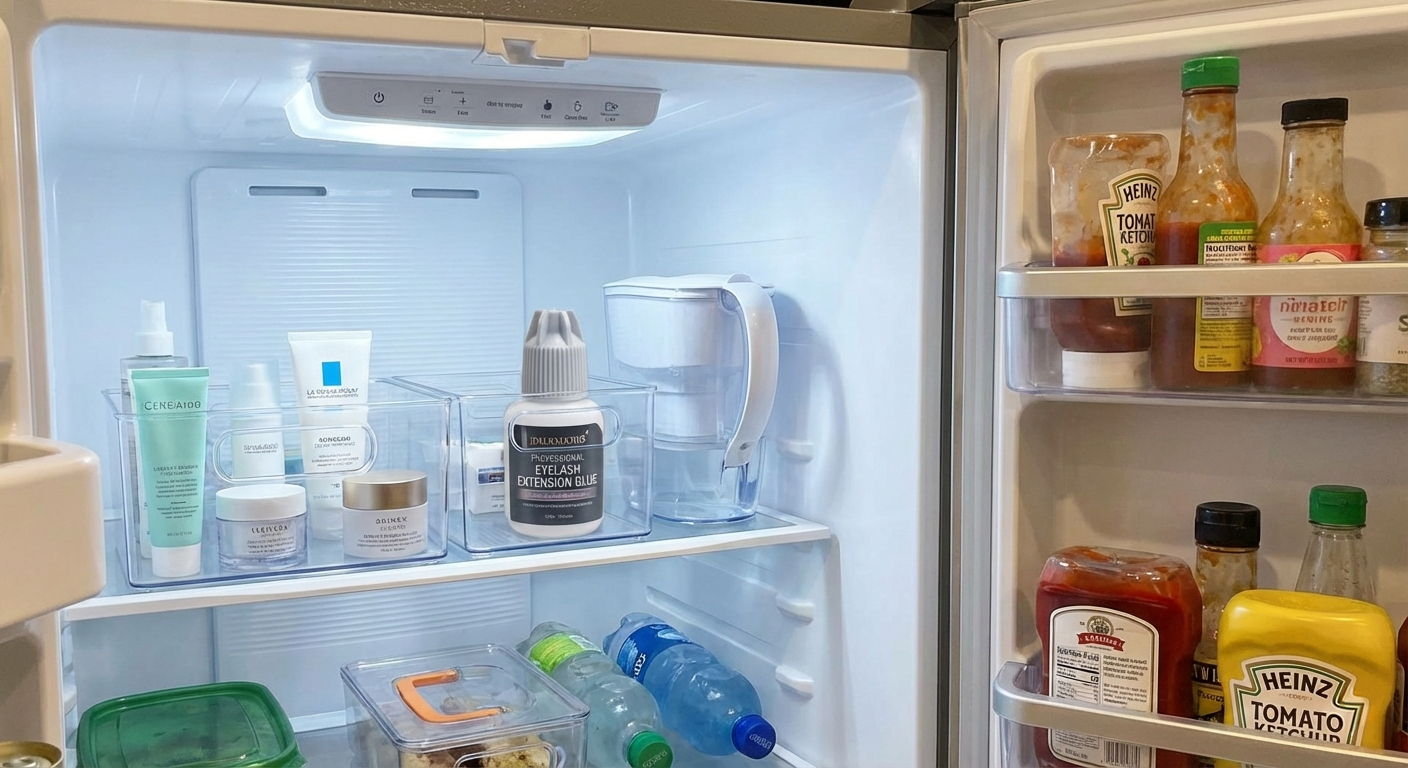
2. Always “Seale and Prevent Moisture” to Avoid Odor Transfer Refrigerators contain food and fruit, which not only create high humidity but also produce unpleasant odors. Placing the glue bottle directly in the refrigerator can easily cause it to absorb moisture and may even pick up food smells (such as onion or garlic), which can be embarrassing for clients during the application process.
Correct Practice: After each use, tighten the cap and place the glue in a sealed bag (or container) to prevent moisture and odors. It’s recommended to prepare a dedicated “glue storage box” for only use with application tools, avoiding contact with food.
3. Don’t “Store for Long Periods After Opening” and Avoid Repeated Refrigeration
Even when refrigerated, it’s recommended to use the glue within 2-3 months after opening. Repeatedly opening the cap allows air and moisture to enter, accelerating spoilage; moreover, frequent transfers between refrigerator and room temperature can cause sudden temperature changes, damaging the stability of the glue’s components and shortening its lifespan.
Finally, in conclusion: Proper Storage = Save Money + Good Results
In fact, the “lifespan” of eyelash extension glue depends half on product quality and half on storage methods. Premature spoilage due to improper storage is not only a waste of money but also affects grafting results, making it uneconomical. Remember these 3 key points:
① Regular quick-drying adhesives must be refrigerated; UV adhesives and hypoallergenic adhesives are recommended to be stored in the refrigerator.
② Allow the adhesive to warm to room temperature before opening.
③ Use within 2-3 months of opening.